

With the benchmark price for a Surrey condo hitting $483,800 in mid-2026, you might wonder if the era of the easy investment is officially over. While our city remains one of BC’s most vibrant growth hubs, calculating cash flow on a rental property in Surrey has become a high-stakes game. A single overlooked utility hike or an unexpected strata assessment can quickly turn a promising asset into a monthly liability that drains your bank account. It's a challenge that even seasoned local investors are feeling right now.
We know it’s stressful to watch entry prices climb while BC’s 2.3% rent increase cap limits your flexibility. Our team is here to take that weight off your shoulders by providing the clarity you deserve. This guide delivers a reliable, spreadsheet-ready formula designed specifically for the current Surrey market. We'll walk you through the real numbers, from the 2.6% property tax hike to realistic vacancy rates for 2026. By the end of this article, you'll have the professional tools and the local data needed to decide with total confidence if a property is a winner or a pass.
Key Takeaways
- Learn why relying on appreciation alone is a risky move in 2026 and how to build a monthly buffer that protects your investment.
- Discover the step-by-step process for determining your Net Operating Income while accounting for Surrey’s 2026 property tax and utility increases.
- Master the exact formula for calculating cash flow on a rental property in Surrey to ensure your purchase is a profitable asset rather than a monthly liability.
- Identify high-yield property types, such as homes with basement suites or coach houses, that are currently outperforming the market average.
- Explore how securing a presale or new construction property early can lock in a lower price-per-square-foot for better long-term returns.
The Reality of Rental Cash Flow in Surrey’s 2026 Market
Success in local real estate starts with a clear understanding cash flow. For our local market, this is more than just a financial term. It's the tangible profit left after you've subtracted every operating expense and mortgage payment from your gross rental income. When calculating cash flow on a rental property in Surrey, you must look beyond the surface. In 2026, relying on property appreciation alone is a gamble we don't recommend. You need a consistent monthly buffer to handle the city's 2.6% property tax hike and rising utility rates.
Surrey's rapid transit expansion, specifically the SkyTrain extension to Langley, is reshaping our neighborhoods. These transit corridors provide a stable floor for rental demand. However, the BC Residential Tenancy Act limits 2026 rent increases to just 2.3%. This cap means your initial math has to be perfect. You can't rely on massive rent hikes to fix a bad deal later. We focus on helping you find properties where the numbers work from day one.
Positive vs. Negative Cash Flow in the Fraser Valley
We often talk to investors about the "Cash-on-Cash Return." This metric tells you the actual yield on the cash you’ve invested. Some properties in the Fraser Valley might show "paper losses" due to high initial entry prices, but they remain powerful long-term holds because of mortgage paydown and tax benefits. It’s vital to use a mortgage calculator to see how different interest rates, like the current 4.04% five-year fixed rate, impact your bottom line.
Why Surrey? Demographic Drivers for 2026
Surrey’s population growth is currently outpacing Vancouver. This surge keeps vacancy rates low, especially near transit hubs. Families are moving here in record numbers, looking for the space that townhomes and detached houses provide. In 2026, Surrey remains the primary destination for families seeking affordability, creating a permanent floor for rental demand. This demographic shift makes calculating cash flow on a rental property in Surrey a strategic necessity for anyone looking to build lasting wealth.
Step-by-Step: How to Calculate Your Net Operating Income (NOI) in Surrey
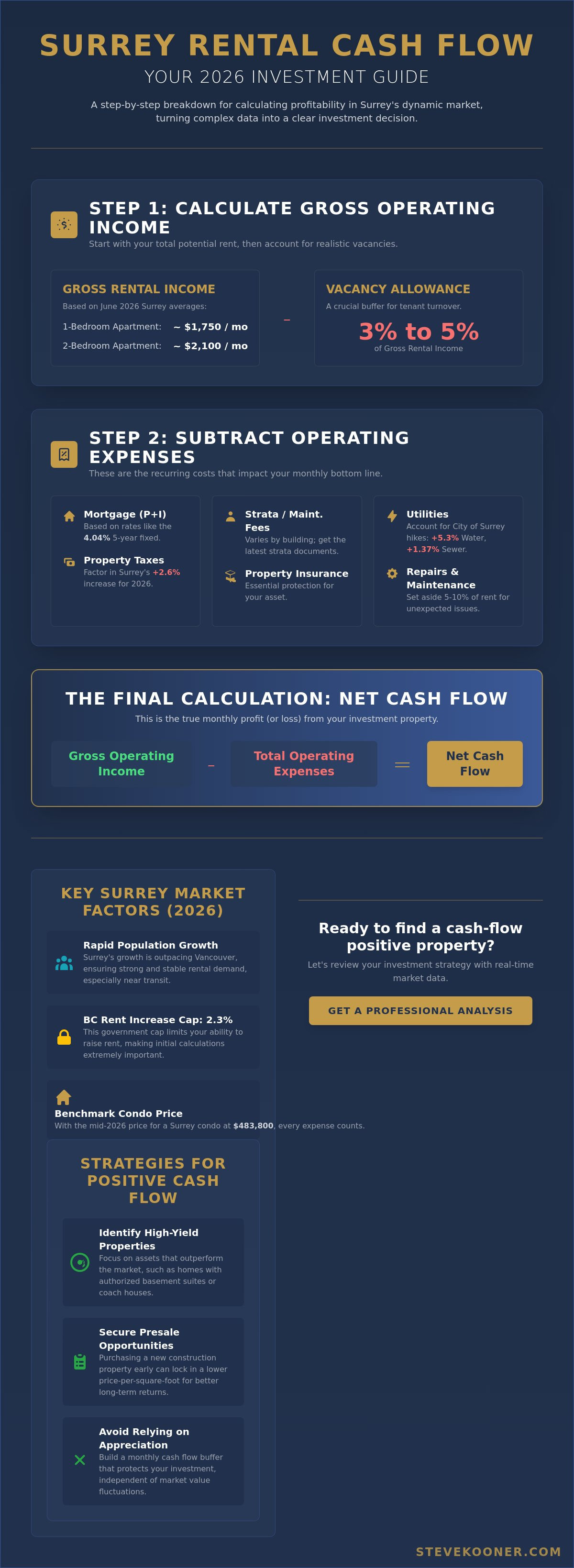
Success in real estate isn't about guessing; it's about the math. When calculating cash flow on a rental property in Surrey, your first step is a realistic look at Gross Rental Income. As of June 2026, a one-bedroom apartment in Surrey averages approximately $1,750 per month, while two-bedroom units sit near $2,100. We always suggest subtracting a 3-5% vacancy allowance right off the top. Even with Surrey's high demand near transit hubs, this buffer protects you during tenant transitions.
Next, you'll need to tally your operating expenses. This is where local knowledge is vital. You must factor in Surrey's 2026 property tax hike of 2.6% and the updated utility rates from City Hall, which include a 5.3% increase for water and 1.37% for sewer. When calculating rental income and expenses, don't overlook the "hidden killers" like maintenance reserves and BC-specific strata fees. Keeping a small percentage of rent aside for repairs ensures an unexpected leak won't sink your monthly profit.
Accounting for BC Taxes and Closing Costs
The BC Property Transfer Tax can significantly impact your initial "cash out" figure, so it's essential to budget for it upfront. You'll also want to confirm your property is exempt from the Speculation and Vacancy Tax (SVT) by ensuring it's properly tenanted. To see how current mortgage rates, like the 4.04% five-year fixed rate, affect your bottom line, visit the Steve Kooner Mortgage Calculator for precise debt service estimates.
The Formula: Putting it All Together
To find your true profit, use this reliable formula: (Monthly Rent - Vacancy) - (Mortgage + Taxes + Strata + Insurance + Utilities + Repairs) = Net Cash Flow. We recommend requesting a Comparative Market Analysis to ensure your rental income projections are grounded in current neighborhood data. If you'd like a second pair of eyes on your numbers, contact us to review your investment strategy together.
Strategies for Achieving Positive Cash Flow in the Fraser Valley
Once you've mastered the math of calculating cash flow on a rental property in Surrey, the next step is choosing the right asset class. In the 2026 market, high-yield properties like those with basement suites or detached coach houses are the gold standard. These "mortgage helpers" significantly lower your debt service ratio and provide a safety net against rising interest rates. While a single condo is a great entry point, a property with two or three income streams often represents the difference between a break-even investment and true monthly profit.
We also see savvy investors leveraging the "Presale Advantage." By purchasing early in a new project, you can lock in a lower price-per-square-foot before the building is even completed. This strategy allows you to benefit from market growth during the construction phase. For those looking for flexibility, an "Assignment of Contract" provides a way to sell your interest before the final closing, which can be a powerful tool if your financial goals shift mid-project. Our team helps you navigate these contracts to ensure you aren't walking into a "money pit" with hidden special assessments or restrictive bylaws.
Top Surrey Neighborhoods for Investors in 2026
Whalley and the University District remain top picks because of their high density and constant demand from student renters. However, Fleetwood is the rising star of 2026. With the SkyTrain extension moving forward and new transit-oriented zoning in place, investors are moving in early to capitalize on future price floors. You can explore our current developments to see which areas align best with your long-term goals.
The Presale Strategy with Steve Kooner
Steve Kooner & Associates provides more than just a list of homes. We give you early access to floor plans specifically chosen for their rental layout efficiency. We also place a heavy emphasis on reviewing the "disclosure statement" in BC presale contracts. This document is your best defense against unexpected changes to the building’s timeline or costs. If you're ready to stop guessing and start building wealth, contact Steve Kooner & Associates for a personalized Surrey investment strategy session. We're here to help you pull the trigger with total confidence.
Take the Next Step Toward Your Surrey Investment Goals
Building a profitable real estate portfolio in 2026 requires more than just picking a great neighborhood. It demands a commitment to the data. By now, you understand that calculating cash flow on a rental property in Surrey means accounting for every utility hike and tax adjustment while targeting high-yield assets like suites or strategic presales. These numbers aren't just figures on a page; they're the foundation of your long-term financial freedom.
You don't have to navigate these complex variables alone. As specialists in Surrey presale developments with expert market knowledge of the Fraser Valley, our team is here to guide you. We provide our partners with access to exclusive early-release floor plans designed to maximize rental efficiency. Whether you're a first-time investor or looking to expand your holdings, we'll help you find the clarity you need to move forward with certainty.
Ready to turn these insights into action? Book a Surrey Investment Strategy Consultation with Steve Kooner today. Let's work together to ensure your next investment is a resounding success.
Frequently Asked Questions
What is a good cash-on-cash return for a Surrey rental property?
A realistic cash-on-cash return in the 2026 Surrey market usually sits between 3% and 5%. While these numbers might seem modest compared to smaller markets, they reflect the stability and low vacancy rates of the Fraser Valley. Investors who prioritize properties with basement suites or coach houses often see their returns trend toward the higher end of that scale because of the multiple income streams.
How much should I set aside for maintenance on a Surrey condo vs. a detached home?
We recommend setting aside 1% of the home's value annually for detached properties and roughly 0.5% for condos. For a detached home in Surrey, this fund protects your cash flow from large expenses like roof repairs or furnace replacements. With condos, your strata fees handle the building's exterior, so your private reserve is primarily for interior wear and tear like appliances, flooring, and painting.
Do I have to pay GST on a rental property purchase in Surrey?
GST of 5% applies to the purchase of all new construction homes and presale units in British Columbia. This is a vital detail when calculating cash flow on a rental property in Surrey, as it adds to your total acquisition cost and affects your initial ROI. If you're buying a resale property that has been previously lived in, you typically won't have to worry about GST, though you should always confirm the tax status during your due diligence.
How does the BC Residential Tenancy Act affect my cash flow?
The Act limits your ability to raise rent, with the 2026 maximum allowable increase set at 2.3%. Because your expenses like property taxes and utilities may rise faster than this cap, your initial lease agreement is your most important tool. You need to ensure your starting rent provides enough of a buffer to absorb these annual cost increases without turning your investment into a monthly liability.
Disclaimer
"Not intended to solicit buyers or sellers that are under current agency agreement" "Each RE/MAX office is independently owned and operated"


