

What if the most important number in your 2026 home purchase isn't your mortgage rate, but a calculation hidden deep inside a stack of strata documents? For many buyers in Langley and Surrey, the monthly cost feels like a moving target. It's natural to feel uneasy about whether a developer's presale estimate is realistic or if a surprise special levy is lurking around the corner. You want to know exactly how are strata fees calculated in BC before you sign, and we're here to pull back the curtain on that process.
We'll unlock the mystery of strata math together, showing you how unit entitlement and the building's operating budget dictate your contribution under the BC Strata Property Act. You'll learn to spot a healthy budget and understand how 2026 insurance trends impact your bottom line. By the end, you'll have the confidence to make an informed investment in the Fraser Valley.
Key Takeaways
- Understand how the BC Strata Property Act protects you by requiring a transparent, member-approved annual operating budget.
- Master the math behind your monthly costs by learning exactly how are strata fees calculated in BC using the Unit Entitlement formula.
- Get the facts on presale disclosure statements so you can anticipate potential fee adjustments once your new building's council takes over.
- Empower yourself to spot a well-managed building and move into your 2026 home with total financial clarity.
The Foundation: The Strata Property Act and the Annual Budget
Every strata development in Langley and Surrey operates under a specific legal framework. The BC Strata Property Act serves as the rulebook, ensuring that your monthly contributions are handled with transparency and fairness. Unlike a fixed rent payment, your strata fee is a moving target that reflects the actual cost of running your condominium or townhome community. To understand how are strata fees calculated in BC, you first need to look at the annual budget, which is a detailed forecast of every dollar the building expects to spend.
To better understand this concept, watch this helpful video:
Each year, the strata council drafts this budget to cover everything from insurance premiums to elevator maintenance. This isn't a unilateral decision; owners must review and approve the figures at the Annual General Meeting (AGM). Once the community votes, the total required amount is divided among the residents. This annual recalculation ensures that fees stay aligned with real-world inflation and building needs.
The Two Pillars: Operating Fund vs. Contingency Reserve Fund (CRF)
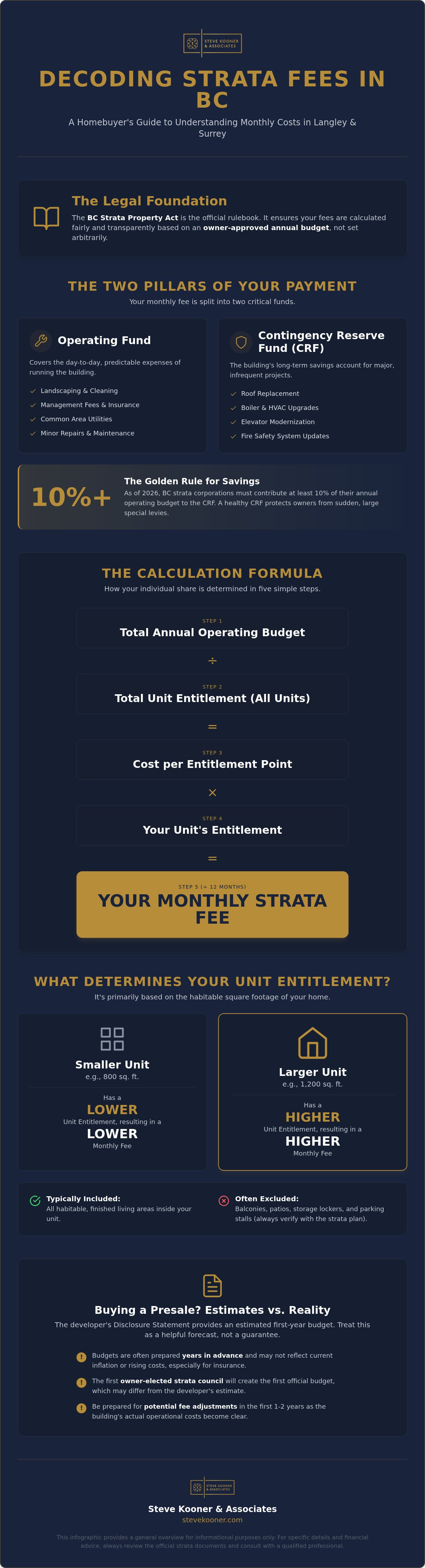
Your monthly payment is split into two distinct buckets. The Operating Fund handles the "here and now" expenses. This includes landscaping, professional management fees, and utilities for common areas. It keeps the lights on and the grass trimmed. Knowing the split between these funds is essential for grasping how are strata fees calculated in BC and why your monthly statement might change.
The Contingency Reserve Fund (CRF) acts as the building's emergency savings account. It’s reserved for major, infrequent projects like replacing a roof or updating fire safety systems. In BC, strata corporations must contribute at least 10% of their operating budget to the CRF annually as of 2026. Maintaining a healthy CRF protects you from sudden, large out-of-pocket expenses known as special levies.
The Calculation Formula: Unit Entitlement and Your Share
Once the strata corporation approves the annual budget, the next step is determining how much each owner contributes. This is where unit entitlement comes into play. It's a specific number assigned to your property that represents your proportional share of the entire building. The developer establishes this figure when the building is first created and registers it at the Land Title Office, meaning it remains constant unless a significant legal change occurs.
To see how are strata fees calculated in BC, use this standard equation: (Total Annual Budget / Total UE of all units) x Your Unit’s UE = Your Annual Fee. Divide that total by 12, and you have your monthly payment. This math ensures that the community's financial burden is distributed logically. It prevents arbitrary fee hikes and gives you a clear window into your financial obligations.
Why Square Footage is the Deciding Factor
Generally, your unit entitlement is based on the habitable square footage of your home. Larger floor plans in Langley or Surrey developments naturally carry a higher UE, meaning those owners pay a larger portion of the maintenance and insurance costs. It’s a fair trade; larger units hold a bigger share of the building's value. However, it's a common misconception that all space counts. In many cases, balconies, patios, and storage lockers are excluded from the UE math, though you should always verify the specific strata plan for your building.
Understanding these costs is vital for your overall financial health and mortgage eligibility. We recommend using our mortgage calculator to see how these monthly fees fit into your debt-service ratios. If you're comparing different buildings in the Fraser Valley, we can help you analyze the strata documents to ensure the math aligns with your long-term goals.
Strata Fees in Presales: Estimates vs. Reality in 2026
When buying a presale in Langley or Surrey, the developer provides a Disclosure Statement. This document includes a projected budget for the first year of the building's life. It’s a helpful starting point, but you must remember these are just estimates. As explained in the BC government's guide to strata budgets, the initial figures are often prepared years in advance. They might not account for current insurance spikes or the true cost of full occupancy.
By year two, reality often sets in. Once the first Strata Council takes over governance from the developer, they frequently find that the interim budget was too lean. This is where budget shock can happen. If you're looking at a resale property instead, always request a "Form B" Information Certificate. This document reveals the unit's exact monthly fee and whether the building is facing any pending legal or financial hurdles. It's a vital tool for understanding how are strata fees calculated in BC for established communities.
Managing the Transition from Developer to Strata Council
Smart buyers in the Fraser Valley look for realistic budgets rather than the lowest ones. A low fee might look attractive on a marketing brochure, but it can lead to massive jumps later. You can use our data on current developments to compare fees across similar projects in Surrey and Langley. This comparison ensures you aren't walking into an underfunded building. When reviewing a budget, use this simple health checklist:
- CRF balance: Does it meet or exceed the mandatory 10% minimum contribution?
- Insurance premiums: Are the numbers based on a recent 2026 appraisal?
- Utility costs: Are common area expenses for pools or gyms properly accounted for?
Taking these steps gives you peace of mind and protects your investment from day one. It's about ensuring your 2026 purchase is as stable as it is beautiful.
Take the Guesswork Out of Your 2026 Property Purchase
Understanding how are strata fees calculated in BC is the first step toward a stress-free homeownership journey. You now know that your monthly payment isn't a random number; it's a reflection of your unit's size and the building's collective health. By looking closely at the annual budget and unit entitlement, you can spot a well-managed community before you ever move in. Whether you're eyeing a sleek new condo in Surrey or a family townhome in Langley, having the right data makes all the difference. Our team brings over 20 years of combined experience in the Fraser Valley market to your side. We specialize in presale contract negotiation and offer exclusive VIP presale alerts to give you a competitive edge.
Contact Steve Kooner & Associates to find your next Fraser Valley home
We're ready to help you navigate the fine print so you can focus on the excitement of your new home.
Frequently Asked Questions
Can strata fees be increased without my consent in BC?
Strata fees change based on the annual budget approved at your building's Annual General Meeting. While you have a vote, the decision is collective. If the majority of owners approve a budget that requires higher contributions, your fees will increase even if you voted against it. This democratic process ensures the building remains financially stable and properly maintained for everyone in the community.
Do strata fees include property taxes or home insurance?
Your monthly fees cover the building's master insurance policy, which protects the structure and common areas. They don't include your personal property taxes or individual contents insurance. You'll still need to pay property taxes directly to the City of Surrey or Township of Langley. We always recommend that our clients secure their own "walls-in" insurance policy to protect their personal belongings and liability.
What happens if the developer’s initial budget estimate is too low?
If the first-year expenses exceed the developer's estimate by more than 10%, the developer might owe the strata corporation a penalty. However, this doesn't stop your fees from going up. Once the owners take control, the budget is adjusted to meet actual costs. This is why our team helps you analyze Disclosure Statements to ensure the math is realistic for the current market.
Are strata fees higher for townhomes or condos in the Fraser Valley?
Condo fees are typically higher per square foot than townhome fees. High-rise buildings require more utility costs for elevators, hallways, and complex fire systems. In the Fraser Valley, townhomes often have simpler shared infrastructure, which keeps costs down. Knowing how are strata fees calculated in BC allows you to weigh these monthly costs against the lifestyle benefits of each property type.
Disclaimer
"Not intended to solicit buyers or sellers that are under current agency agreement" "Each RE/MAX office is independently owned and operated"


