

What if the tenant currently living in your home was actually the secret to securing a higher sale price instead of a hurdle to clear? While many landlords view the process with anxiety, mastering the selling a tenanted property in BC rules for 2026 can turn a potentially stressful transition into a strategic win for everyone involved. You might be worried about navigating the new three month notice requirements or keeping your home in showing-ready condition, and those concerns are completely valid in today's shifting market.
We understand that the recent legislative updates can feel overwhelming, especially when you just want a smooth, predictable sale without the fear of an RTB dispute. We're here to help you move forward with total confidence. This guide will show you exactly how to handle legal requirements while using practical strategies to keep your tenants cooperative and your property value high. We will walk through the essential RTB web portal steps, mandatory compensation figures, and the communication habits that protect you from costly bad faith penalties while ensuring your property stands out to buyers.
Key Takeaways
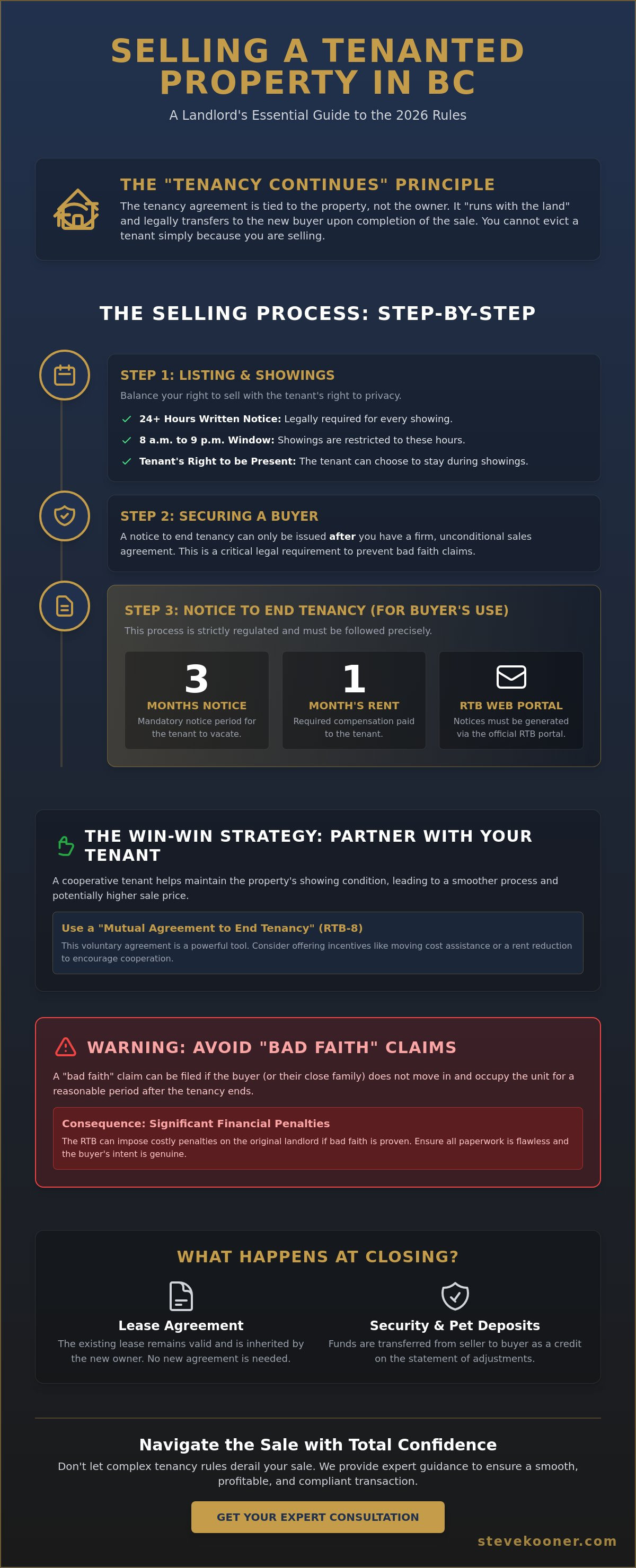
- Understand the "Tenancy Continues" principle, where the existing lease agreement legally transfers to the new owner upon completion of the sale.
- Maintain legal compliance during the listing phase by providing at least 24 hours of written notice for every showing between 8 a.m. and 9 p.m.
- Master the latest selling a tenanted property in BC rules, including the mandatory three-month notice period and the required one-month rent compensation for the tenant.
- Learn how to transform your tenant into a cooperative partner through strategic incentives that keep your property in peak showing condition for potential buyers.
- Protect your investment from "bad faith" penalties by ensuring all notices are generated through the official RTB web portal and backed by a firm sales agreement.
BC Residential Tenancy Rules: The 'Tenancy Continues' Principle
The most important thing to understand about the selling a tenanted property in BC rules is that the tenancy agreement "runs with the land." This legal concept means the contract is tied to the physical property, not the specific person who signed it as the landlord. When you decide to list your home, it's vital to remember that the act of selling is not a legal cause for eviction. Your tenant's rights remain fully intact throughout the entire process, and they're entitled to stay in their home unless the law provides a specific pathway for the tenancy to end.
To understand the broader context of these protections, a Landlord-Tenant Law Overview shows how these regulations are designed to provide stability for residents. In British Columbia, the buyer essentially steps into your shoes. They inherit the existing lease terms, the current rent amount, and all the responsibilities you held. If you're unsure how your current lease impacts your home's marketability, our Home Evaluation service can provide clarity on your specific situation and help us build a strategy that respects these legal boundaries.
There are instances where a tenant might choose to leave voluntarily. We often see success with a Mutual Agreement to End Tenancy (Form RTB-8). This is a collaborative document where both parties agree to end the lease on a set date. It's a great option if the tenant wants to avoid the disruption of showings and you prefer to market a vacant home. It requires genuine cooperation and cannot be forced, which is why we prioritize building a positive relationship with your tenants from day one.
What Happens to the Lease After the Sale?
The transition is often simpler than many landlords expect. You don't need to sign a new tenancy agreement once the property sells because the existing contract remains fully valid. During the closing process, any security or pet damage deposits are transferred to the new owner as a credit on the statement of adjustments. The buyer becomes responsible for returning these funds when the tenant eventually moves out. If your tenant is on a fixed-term lease, they have the right to stay until the end of that term, regardless of who owns the home. Month-to-month tenancies offer a bit more flexibility for buyers who intend to move in, but they still require strict adherence to the latest 2026 notice periods.
Key 2026 Legislative Updates for BC Landlords
The 2026 landscape for the Residential Tenancy Act (RTA) places a heavy emphasis on tenant stability and fair treatment. One critical area involves the tenant's right to "quiet enjoyment" of their home. In the context of 2026 property marketing, the 'peace and quiet' clause means your right to show the home must never infringe upon the tenant's right to reasonable privacy and freedom from unreasonable disturbance. Failing to follow the selling a tenanted property in BC rules can lead to significant administrative penalties from the RTB. These fines have increased to discourage non-compliance, making it essential to have a professional partner who understands the nuances of the law and can mediate effectively between all parties.
Rules for Showings and Open Houses: Maintaining Compliance
Successfully marketing your home depends on accessibility, but when a tenant is involved, you must balance your right to sell with their right to privacy. The 24-hour rule is the cornerstone of selling a tenanted property in BC rules. Specifically, you must provide at least 24 hours of written notice before each showing. This notice isn't just a courtesy; it's a legal requirement that must state the date, the specific time of entry, and the reason for the visit. Legally, you can only schedule these entries between 8 a.m. and 9 p.m., ensuring the tenant's daily life isn't unfairly disrupted.
While you have the right to show the property, the tenant also has the right to be present or absent during the visit. Most residents prefer to be away, but some may choose to stay. It's often helpful to review Tenant Rights When Selling a Property to understand their perspective. Open houses can be more complex than private showings. While the law allows entry for a "reasonable purpose," some tenants find the high foot traffic of an open house to be an unreasonable disturbance. We usually recommend focusing on scheduled private showings or obtaining clear, written consent from the tenant before hosting a public open house to avoid potential friction.
Proper Notice Requirements in the Digital Age
In 2026, the method you use to deliver notice is just as important as the notice itself. While paper notices taped to the door or placed in the mailbox are classic, email is legally recognized only if the tenant has previously agreed to this method in writing. If you aren't handing the notice directly to the tenant, the "three days deemed served" rule applies. This means if you post a notice on the door on Monday, it isn't legally considered "received" until Thursday, making Friday the earliest possible showing day. Documenting every notice sent helps prevent "unauthorized entry" claims and keeps the process transparent.
Handling Tenant Refusal and 'Quiet Enjoyment'
What happens if a tenant repeatedly blocks access? It's a stressful situation, but you shouldn't try to force entry or engage in a confrontation. There's a fine line between exercising your right to show the home and harassing a resident. If a tenant refuses entry after receiving proper notice, they may be in breach of the tenancy agreement. However, the best approach is always mediation. Our team at Steve Kooner & Associates specializes in building bridges with tenants to find a schedule that works for everyone. By treating the tenant with respect and acknowledging their need for quiet enjoyment, we usually find that resistance turns into cooperation, ensuring your property remains ready for potential buyers.
Ending Tenancy for Buyer's Use: The 4-Month Rule
One of the most common points of confusion for landlords is the difference between selling a property and ending a tenancy for the buyer's use. In British Columbia, you cannot end a tenancy simply because you want to list the home. A tenancy can only be terminated if the buyer, or a close family member, intends to occupy the unit as their primary residence. While planning your closing date, it is vital to understand that the selling a tenanted property in BC rules as of 2026 require a specific three-month notice period once a firm sale is in place.
This transition also carries a financial obligation. You must provide the tenant with compensation equivalent to one month's rent. This is often handled by allowing the tenant to stay for the final month rent-free, or by paying them the amount directly on or before the effective date of the notice. If your tenant has a fixed-term lease, you cannot end the tenancy before the end of that term, even if the buyer intends to move in. We often help our clients coordinate these timelines during the Contract & Transaction Management phase to ensure no one is left with an unexpected legal hurdle.
The Process for Serving the Two-Month or Four-Month Notice
The process must be followed with precision to be legally enforceable. First, you must have a firm sales agreement where all subjects have been removed. The buyer must then provide you with a written request asking you to serve the notice on their behalf. Once you have this request, you must use the official Residential Tenancy Branch (RTB) web portal to generate the notice. Using any other form or an outdated document will likely result in the notice being nullified if the tenant disputes it. Remember, tenants have 21 days to dispute a notice for purchaser's use through the RTB.
The 12-Month Occupancy Rule and Penalties
British Columbia has strict "Good Faith" requirements to prevent wrongful evictions. If a buyer ends a tenancy to move in, they must occupy the property for at least 12 months. If they fail to do so, or if they re-rent the unit sooner, they may be ordered to pay the former tenant a penalty equivalent to 12 months' rent. This is a massive financial risk. As a seller, you can protect yourself by ensuring the buyer's intent is clearly documented in the contract. We work closely with our partners to draft precise language that shields you from liability regarding the buyer's future actions, giving you the peace of mind you deserve during the sale.
Strategic Marketing for Fraser Valley Tenanted Properties
While mastering the legal selling a tenanted property in BC rules provides you with a solid foundation, the actual success of your sale often hinges on the human element. In a market like the Fraser Valley, where active listings reached 9,816 in April 2026, standing out requires more than just a sign on the lawn. A cooperative tenant is your most valuable marketing asset. When a resident feels respected and involved, they're far more likely to keep the home tidy, accommodate last minute showing requests, and speak positively about the neighborhood to potential buyers.
We've found that small, thoughtful gestures go a long way in building this partnership. Consider offering your tenant a professional cleaning service once a week while the home is on the market. This ensures your property is always "photo-ready" without adding a burden to their schedule. Other effective incentives include gift cards to local restaurants for use during open houses or a modest rent rebate for the month the home is listed. These strategies transform the selling process from an intrusion into a collaborative effort that protects your property value.
The 'Cooperation Bonus' Strategy
Think of a "cooperation bonus" as a strategic investment rather than an expense. By offering a "cash for keys" arrangement or a financial bonus upon a successful, dispute-free closing, you align your interests with the tenant's. A cooperative tenant who welcomes buyers with a positive attitude significantly improves the 'vibe' of a showing, making the home feel more inviting and less like a legal battleground. This positive atmosphere is often the deciding factor for buyers who are wary of inheriting a difficult tenancy situation. If you're ready to see how your property stacks up, our Home Pricing Strategy can help you factor these marketing nuances into your final goal.
Fraser Valley Market Dynamics in 2026
The 2026 market in the Fraser Valley is currently a buyer's market, with a sales-to-active listings ratio of 11% as of April. This means buyers have plenty of options and can afford to be picky. In Surrey and Langley, positioning is everything. If you're targeting investors, we highlight the stability of the current tenancy and the potential for long term growth. For end-users, we focus on the transition plan and the clear timelines established by the selling a tenanted property in BC rules.
In areas like the Abbotsford housing market, local expertise is vital. With median home prices hovering around $969,000, buyers are looking for transparency and professional management. We specialize in navigating these local nuances, ensuring your marketing materials reflect the true potential of the home while respecting the tenant's privacy. Our team provides the Professional Marketing & Exposure needed to cut through the noise and find the right buyer who appreciates the value of your tenanted investment.
Navigating the Sale with Steve Kooner & Associates
Selling a tenanted home is a delicate dance between legal precision and human relations. Our team at Steve Kooner & Associates understands that your rental property represents a significant portion of your financial portfolio. Whether you're navigating the sale of a detached home in Surrey or a modern condo in Abbotsford, the selling a tenanted property in BC rules for 2026 demand strict adherence to procedure. We don't just list your home; we act as your strategic partner and professional mediator. We ensure every interaction with your tenant is handled with the utmost respect, preserving the "quiet enjoyment" they're legally entitled to while maximizing your property's exposure to the right buyers.
From the initial staging advice to the final signature on the contract, we manage the complexities of the Residential Tenancy Act so you don't have to. We specialize in Investment Property Sales & Purchases, which means we know exactly how to draft contracts that protect you from future RTB disputes. Our goal is a smooth, transparent transaction where the buyer, the seller, and the tenant all feel respected. This professional balance is what allows us to secure top value for our clients even in the current buyer's market, where the Fraser Valley saw 9,816 active listings in April 2026.
Why Professional Representation Matters for Tenanted Sales
The "heavy lifting" of a tenanted sale often involves the meticulous coordination of notice periods and showing schedules. We handle the delivery of all legal notices and ensure they meet the rigorous standards set by the Fraser Valley Real Estate Board. By acting as the primary point of contact for your tenants, we remove the emotional friction that can sometimes arise during a sale. We invite you to get a home evaluation to see your property's value in today's market and learn how we can tailor our approach to your specific tenancy. Our local expertise ensures that your sale stays on track and compliant with all selling a tenanted property in BC rules.
Ready to Sell Your Investment Property?
Every rental situation is unique. A "one size fits all" approach simply doesn't work when you're dealing with someone's home. We develop a customized strategy for every client, ensuring your specific lease terms and tenant relationships are factored into our marketing plan. This personalized touch is why our clients move forward with confidence. You can access our resources for more landlord-specific guides and market updates. When you're ready to move forward, Contact Steve Kooner & Associates to plan your 2026 sale. Let us help you achieve a successful closing with the peace of mind that comes from expert guidance and deep local roots.
Take the Next Step Toward a Successful Sale
Selling your rental property doesn't have to be a source of stress or legal uncertainty. By focusing on clear communication and strictly following the selling a tenanted property in BC rules, you can ensure a smooth transition that protects your equity. The 2026 landscape prioritizes transparency, from using the mandatory RTB web portal for notices to providing the required one-month rent compensation. When you treat your tenant as a partner in the process, you set the stage for better showings and a higher final sale price.
Our team at Steve Kooner & Associates specializes in Fraser Valley investment properties, bringing expert knowledge of 2026 RTB regulations to every transaction. We have a proven track record in Langley and Surrey sales, helping landlords navigate complex tenancies with confidence and ease. We're here to handle the details so you can focus on your next big move. Book a Consultation for Your Tenanted Property Sale today and let's build a strategy that works for you. You've worked hard for your investment; we're here to make sure the sale is just as rewarding.
Frequently Asked Questions
Can I evict my tenant just because I want to list my house for sale in BC?
No, you cannot evict a tenant simply for listing your property. The selling a tenanted property in BC rules state that a tenancy continues until a firm contract is in place and the buyer requests in writing that you serve notice for their personal use. If the buyer is an investor, they simply inherit the existing lease and the tenant stays in place under the same terms.
How much notice do I need to give a tenant for a showing in 2026?
You must provide at least 24 hours of written notice before every showing. This notice needs to include the date, a specific time window between 8 a.m. and 9 p.m., and the reason for entry. While you have the legal right to show the unit after giving notice, it's always best to coordinate with your tenant to ensure the home is in peak condition for potential buyers.
What is the compensation required if the buyer wants to move in?
You are legally required to provide the tenant with compensation equal to one month's rent. This payment is due on or before the effective date of the notice to end tenancy. Many landlords choose to let the tenant stay for their final month rent-free to satisfy this requirement simply and avoid any financial disputes during the final stages of the closing process.
Can a tenant refuse to allow photos of the property for the listing?
Tenants cannot legally block you from taking marketing photos, but they do have a right to privacy regarding their personal belongings. It's best to work together to ensure no sensitive items like family photos or valuable collections are visible. If a tenant is uncooperative, professional real estate teams can often mediate to ensure you get high quality photos while respecting the resident's living space.
What happens if a buyer doesn't move in after I've evicted the tenant for them?
If the buyer fails to occupy the property for at least 12 months, they may be ordered to pay the former tenant 12 months' rent as a penalty. This "bad faith" rule is strictly enforced by the RTB in 2026 to prevent wrongful evictions. As the seller, you should ensure the buyer's intent to occupy is clearly documented in your contract to protect yourself from any future claims.
Do I have to pay the tenant's moving expenses in BC?
There is no legal requirement in British Columbia for a landlord to pay a tenant's specific moving costs. However, the mandatory one month of rent compensation is often used by tenants to cover these expenses. Following the selling a tenanted property in BC rules correctly ensures you meet your financial obligations without paying for additional, non-required costs during your transition.
Can I sell a tenanted property to another investor without ending the tenancy?
Absolutely, you can sell to another investor without ending the tenancy. In this scenario, the new owner simply becomes the landlord and inherits the existing tenancy agreement exactly as it is. This is often an attractive option for buyers looking for immediate rental income and avoids the need for serving notice or paying the mandatory one month of rent compensation.
What should I do if my tenant is being hostile during the selling process?
If a tenant becomes hostile, the best course of action is to lean on professional representation and strict documentation. Avoid personal confrontations and ensure every communication is in writing and follows RTB guidelines exactly. We often act as a neutral third party to de-escalate tensions and ensure the showing process remains professional and productive for your sale without risking legal disputes.
Disclaimer
"Not intended to solicit buyers or sellers that are under current agency agreement" "Each RE/MAX office is independently owned and operated"


