

An $800,000 home in BC carries C$14,000 in base property transfer tax before exemptions or surcharges. If you’re asking how to calculate property transfer tax in BC, apply each rate only to the portion of the property’s fair market value in that tax bracket. Because the calculation is progressive, the total can be easy to misjudge at a glance.
This guide walks through the value bands and shows how to estimate the base tax. It also explains when first-time buyer and newly built home exemptions may apply, and flags additional tax that can affect some foreign buyers. Before completion, confirm the applicable value, eligibility details, and required documents with your lawyer or notary so you can account for the tax in your purchase budget.
Key Takeaways
- Learn how to calculate property transfer tax in BC by applying each progressive rate to the portion of fair market value within its band.
- Check whether a buyer- or property-specific surcharge could change your estimate, including rules that may apply in the Fraser Valley.
- Review first-time buyer and newly built home exemption criteria before relying on a reduced tax estimate.
- Before completion, confirm the property value, ownership details, location, and exemption documents with your lawyer or notary.
How to calculate BC property transfer tax from a property's value
To calculate property transfer tax in BC, apply each rate only to the portion of fair market value within that bracket. The rates are progressive, not one percentage applied to the entire property value. The Province of British Columbia describes property transfer tax as a tax on taxable property transfers registered in BC. For broader context, see Property tax in British Columbia.
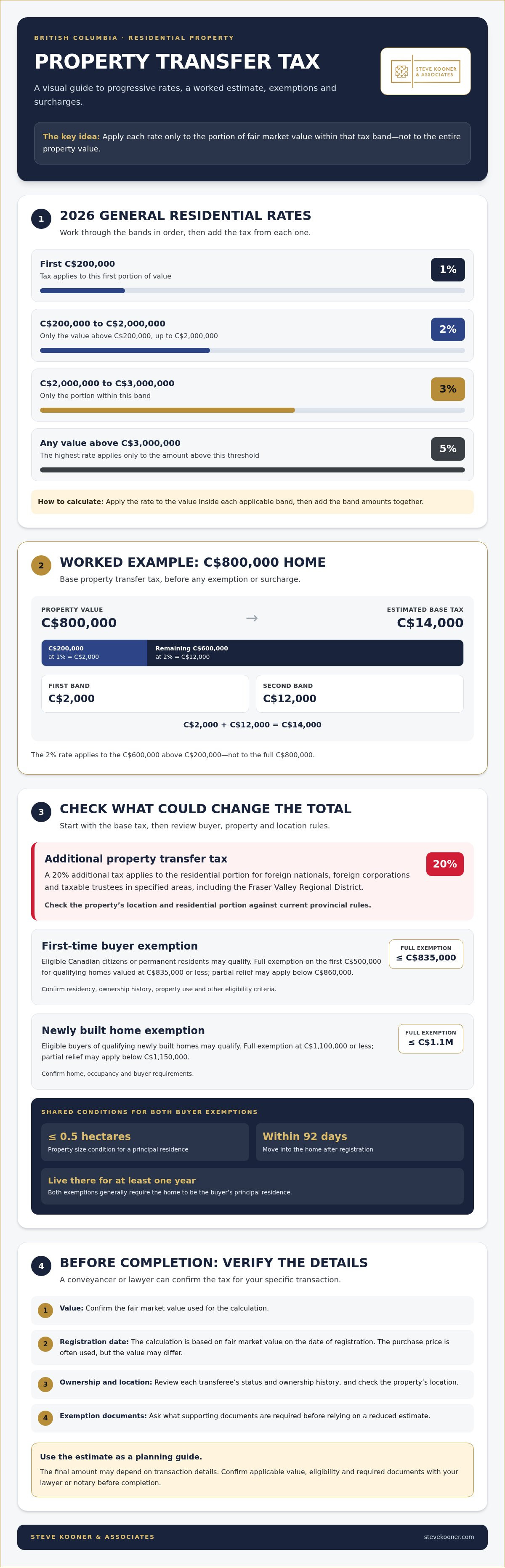
For residential property in 2026, the general rates are 1% on the first C$200,000, 2% on the portion from C$200,000 to C$2,000,000, 3% from C$2,000,000 to C$3,000,000, and 5% on any value above C$3,000,000.
To estimate the base tax, work through the brackets in order:
- Apply 1% to the first C$200,000.
- Apply 2% to the value above C$200,000, up to C$2,000,000.
- If applicable, calculate 3% on the portion from C$2,000,000 to C$3,000,000, then 5% on any amount above C$3,000,000.
- Add the amounts from each bracket.
Hypothetical example: For a home valued at C$800,000, the first C$200,000 generates C$2,000 in tax. The remaining C$600,000 is taxed at 2%, adding C$12,000. The estimated base tax is C$14,000, before considering any exemption or surcharge. The key check is that the 2% rate applies only to the value above C$200,000, not to the full C$800,000.
Which property value should you use for the estimate?
The calculation base is the property's fair market value on the date of registration, according to the Province of British Columbia. In many transactions, this is the purchase price, but it may differ. Ask your conveyancer which value applies to your transaction. Treat your calculation as an estimate, not a tax assessment or legal opinion. The final amount may depend on transaction details.
Which BC property transfer tax surcharges and exemptions can change the result?
Start with the base tax, then check whether an adjustment applies. A surcharge may add tax, while an exemption may reduce or eliminate some or all of the base amount. The Province of British Columbia lists the official property transfer tax rates and program rules. Eligibility depends on the specific buyer and property, so don’t assume you qualify based only on a description such as “first-time buyer.”
How do buyer eligibility and property location affect the calculation?
The additional property transfer tax is 20% of the residential portion for foreign nationals, foreign corporations, and taxable trustees in specified areas, including the Fraser Valley Regional District. Exemptions have separate tests. Use the table to identify which rules to check, then confirm your circumstances and documents with a lawyer or notary.
| Adjustment | Who may qualify | Key condition and official verification |
|---|---|---|
| Foreign-buyer tax | Foreign nationals, foreign corporations, taxable trustees | Check the property’s location and residential portion against current provincial rules. |
| First-time buyer exemption | Eligible Canadian citizens or permanent residents | Full exemption on the first C$500,000 for qualifying homes valued at C$835,000 or less; partial relief may apply below C$860,000. Confirm residency, ownership history, property use, and other criteria. |
| Newly built home exemption | Eligible buyers of qualifying newly built homes | Full exemption at C$1,100,000 or less, with partial relief below C$1,150,000. Confirm home, occupancy, and buyer requirements. |
Both buyer exemptions generally require a principal residence on a property no larger than 0.5 hectares, moving in within 92 days of registration, and living there for at least one year. For broader context, read First Time Home Buyer BC Programs. If you’re considering a Fraser Valley purchase, you can discuss your purchase plans with the real estate team. Your lawyer or notary can confirm whether an exemption applies to your circumstances.
How to check your estimate before a Fraser Valley home purchase
Property transfer tax is one part of a purchase budget. Before completion, check the details that could change your initial estimate. A conveyancer or lawyer can confirm the amount payable for your transaction and file the transfer with the Land Title Office.
What should buyers confirm with their conveyancer?
Before registration, ask your conveyancer or lawyer which value and rules apply on the registration date. If you plan to claim an exemption, ask what supporting documents are needed. The Province’s BC property transfer tax exemptions page is a useful reference, but your eligibility depends on the details of your purchase.
- Value: Confirm the fair market value used to calculate the tax.
- Ownership: Review each transferee’s status and ownership history, as these may affect a surcharge or exemption.
- Property type and location: Confirm how the property is classified and whether its location triggers additional tax rules.
- Rates and documents: Check the applicable rates on the registration date and provide any exemption forms or evidence requested.
These checks help turn an estimate of how to calculate property transfer tax in BC into a completion figure you can plan around. You can use the mortgage calculator as a broader budgeting aid, but it doesn’t calculate property transfer tax. For purchase planning in the Fraser Valley, the real estate team can help with your home search, offer, and transaction steps. For tax or legal guidance, rely on your conveyancer or lawyer.
Plan your next steps with confidence
Knowing how to calculate property transfer tax in BC starts with applying progressive rates to the property’s fair market value. Your estimate may change if a surcharge applies or you qualify for an exemption. Confirm the property details, buyer eligibility, and required documents with your conveyancer or lawyer before completion.
Keep the tax in view alongside the rest of your purchase budget. Steve Kooner & Associates offers buyer representation and transaction support, with local experience across Langley and Fraser Valley communities. The team can help you plan your purchase, while your legal professional confirms the tax treatment for your circumstances.
For help planning a purchase in Langley, Abbotsford, Chilliwack, Mission, Hope, Kent, Agassiz, Harrison Hot Springs, Township of Langley, Surrey, North Delta, Maple Ridge, or Pitt Meadows, contact Steve Kooner & Associates. Ask your lawyer or notary to verify your property transfer tax estimate and any exemption before completion.
Frequently Asked Questions
How do you calculate property transfer tax in BC?
Apply each current BC rate to only the portion of the property’s applicable value within that bracket, then add the amounts. Don’t apply the highest rate to the entire value. Also check separately for buyer-, property-, or location-based surcharges and exemptions. Ask your conveyancer or lawyer to verify the current rules and final amount payable.
Is BC property transfer tax based on the purchase price?
Generally, BC property transfer tax is calculated using the property’s fair market value at registration. The purchase price can be evidence of that value, but it isn’t automatically the final tax basis in every situation. Ask your conveyancer to confirm which value applies to your transaction and check current provincial guidance before budgeting for completion.
Can first-time home buyers avoid property transfer tax in BC?
Some first-time buyers may qualify for a full or partial exemption, but it isn’t automatic. Eligibility depends on current program criteria and the property’s characteristics and value. Before relying on a reduced estimate, review the Province of British Columbia’s requirements for the year your transfer will be registered, then ask your conveyancer to confirm your eligibility and required documents.
Does property transfer tax apply to presale homes in BC?
Property transfer tax may apply when a presale is registered. The applicable value, registration timing, and any exemption depend on transaction details and current rules, so don’t assume the original contract price fixes the tax basis. Ask your conveyancer to assess the details. Steve Kooner & Associates supports buyers across Langley, Abbotsford, Chilliwack, Mission, Hope, Kent, Agassiz, Harrison Hot Springs, Township of Langley, Surrey, North Delta, Maple Ridge, and Pitt Meadows.
Disclaimer
"Not intended to solicit buyers or sellers that are under current agency agreement" "Each RE/MAX office is independently owned and operated"


