

What if the number on your latest BC Assessment notice has almost nothing to do with what a buyer would pay for your home today? It's a common source of stress for families in Langley and Abbotsford to see a tax valuation that feels out of sync with the local market value vs assessed value BC. This confusion often leaves you wondering if you're sitting on hidden equity or simply overpaying on your property taxes. We're here to take that weight off your shoulders and provide the clarity you deserve.
This guide breaks down exactly why these numbers differ. You'll learn why the July 1, 2025, valuation date creates a significant time-gap in the 2026 market, how to estimate your home's real-time worth, and the strategies you need to list or buy with absolute confidence in our current Fraser Valley landscape. Let's find your real value together.
Key Takeaways
- Understand that your assessment is a retrospective tool for tax distribution, while market value is the real-time price a buyer is willing to pay.
- Learn why specific home upgrades and local infrastructure projects like the Surrey-Langley SkyTrain cause a divergence in market value vs assessed value BC.
- Master the art of analyzing neighborhood "Sold" data to identify your true equity rather than relying on generic government notices.
- Gain the confidence to use current market data and tools like a mortgage calculator to build a smarter strategy for your next Fraser Valley move.
Assessed Value vs Market Value BC: Understanding the Core Differences
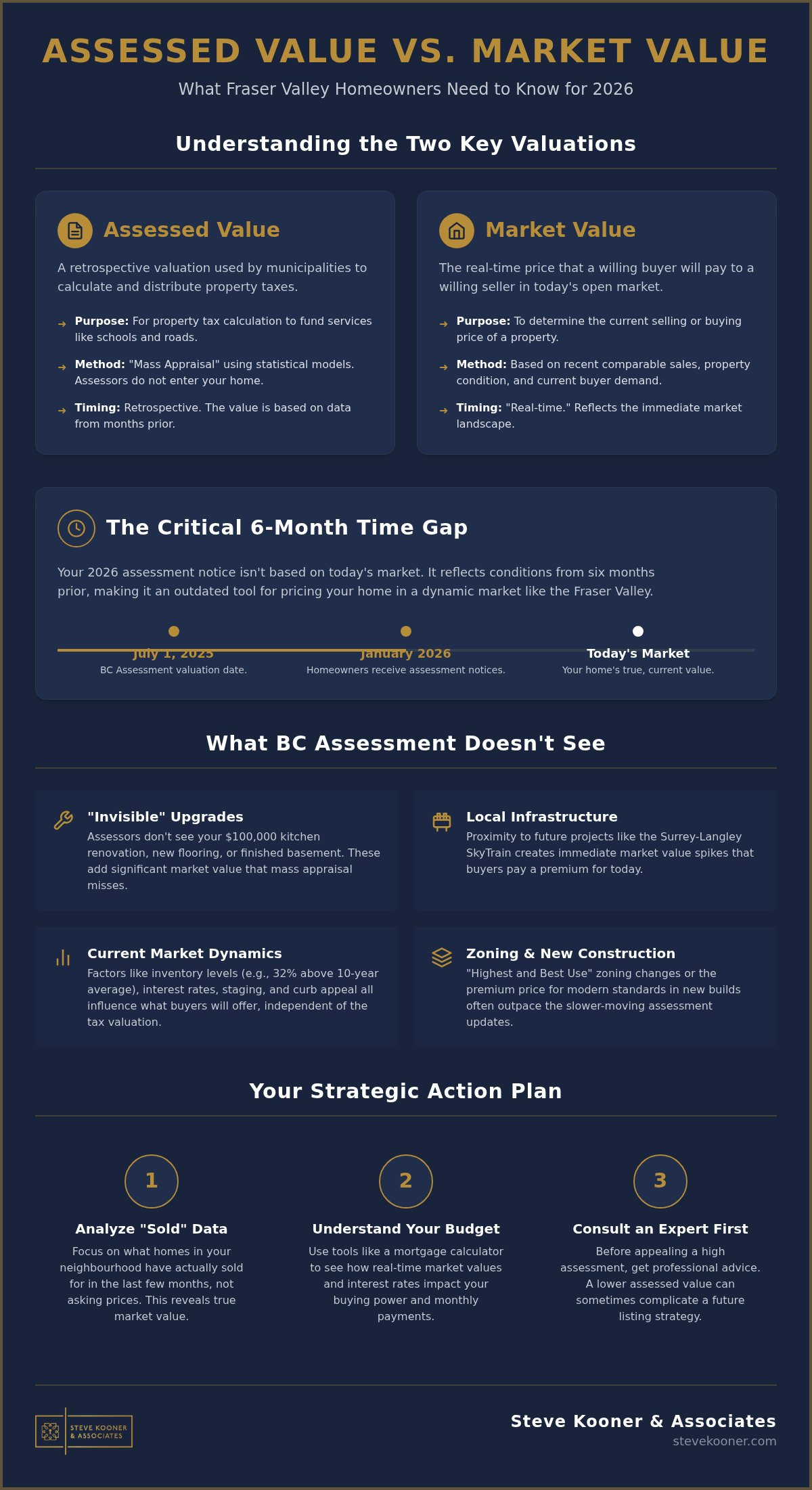
When you open your mail in January, the number you see isn't a real-time price tag. Assessed value is a retrospective figure used by municipalities to distribute property taxes fairly across the community. In contrast, market value represents the actual price a willing buyer pays a willing seller in an open, competitive market today. Understanding the gap between market value vs assessed value BC is essential because BC Assessment relies on "Mass Appraisal," which is a method of valuing thousands of properties simultaneously using statistical models without ever stepping foot inside your home.
There's a significant "Time Gap" that many homeowners miss. Your 2026 assessment is based on market conditions from July 1, 2025. By the time that notice hits your doorstep in January, the data is already six months old. In a shifting Fraser Valley market, that delay makes the assessment a poor tool for pricing a home.
To better understand these concepts, watch this helpful video:
The Purpose of BC Assessment in the Fraser Valley
Local governments in Langley and Abbotsford use these figures to determine revenue for schools and roads. It's helpful to gain perspective by Understanding Tax Assessments as a civic tool. Don't panic if your value jumped; a high assessment doesn't always mean higher taxes. Your bill only climbs if your property's value increased more than the municipal average. To see how your home stacks up, request a Steve Kooner Home Evaluation for a real-time comparison.
Why Your Home Assessment and Sale Price Diverge in 2026
The gap between your tax notice and a real world offer often comes down to what the BC Assessment software simply cannot see. While mass appraisals look at broad neighborhood trends, they frequently miss the "invisible" upgrades that define your home's worth. If you've invested in a $100,000 kitchen renovation or high-end hardwood flooring, those details won't appear on your government notice because assessors rarely step inside. This is a primary driver of the disconnect in market value vs assessed value BC.
Local infrastructure is another powerful factor that creates a rift between these two numbers. In areas like Langley and Surrey, proximity to the future SkyTrain extension creates immediate value spikes. Buyers pay a premium today for future accessibility, a nuance that retrospective tax models often lag behind. This also applies to presale dynamics. New construction pricing in the Fraser Valley often sits significantly above the assessed value of older neighboring stock because you're paying for modern energy standards and warranties. In North Delta or Chilliwack, "Highest and Best Use" zoning changes can also cause market values to skyrocket before the tax assessment catches up.
Market Factors BC Assessment Doesn’t See
Mass appraisals can't measure the "emotional premium" of a move-in ready home. Professional staging and high curb appeal create a competitive environment that drives prices up, regardless of the tax valuation. We also have to consider the current Abbotsford housing market inventory. With active listings sitting 32% above the 10-year average as of July 2026, buyers have more leverage to negotiate. Current interest rates also dictate what people can actually bid, creating a ceiling that a government algorithm doesn't account for. Understanding the nuances of market value vs assessed value BC helps you negotiate with logic rather than emotion. If you're curious about your home's standing, we can help you analyze your true market position.
Strategic Steps for Fraser Valley Homeowners and Buyers
Moving from understanding to action is what sets successful movers apart in our local market. To get a true handle on market value vs assessed value BC, start by looking past active listing prices. Instead, analyze "Sold" data from your specific neighborhood over the last few months. This gives you a grounded view of what people actually pay, rather than what they hope to get. Next, use our mortgage calculator to see how these real-time market fluctuations impact your monthly buying power and budget.
We also recommend consulting an expert before you rush to appeal an assessment. While lowering your tax bill sounds great, it can create a "low value" paper trail that might complicate your future listing strategy. For those looking to sell, remember that your assessment is often a floor. We help you build a pricing strategy that uses that floor as a launchpad, not a ceiling, to ensure you don't leave money on the table.
When to Ignore the Assessment and Trust the Market
Buyers should prioritize comparable sales from the last 60 days above any government notice. A professional Comparative Market Analysis (CMA) is vital because it's what lenders look at when securing your mortgage. Our team at Steve Kooner & Associates specializes in bridging these gaps. We provide the local context that mass appraisals miss, ensuring you make every offer or listing decision with total confidence. Let's work together to find your home's true worth in today's Fraser Valley market.
Master Your Fraser Valley Real Estate Strategy
Understanding the nuances of market value vs assessed value BC is the first step toward a successful move. You now know that while the government looks backward at July 2025 data for property taxes, your home's true worth is driven by today's demand and local transit growth. We've helped families navigate these changes since 2005 with the professional backing of Royal LePage Wolstencroft. Whether you're eyeing a new development near the Surrey-Langley SkyTrain or listing a renovated detached home, having a partner who understands the "invisible" value of your property makes all the difference. We're here to take the stress off your shoulders and turn confusion into clarity.
Get a Free, Accurate Home Evaluation for the 2026 Market
You deserve a strategy built on real-time data and local expertise. Let's work together to unlock your home's full potential in this year's market.
Frequently Asked Questions
Does a low BC Assessment mean I should list my house for less?
No, you shouldn't let a low assessment dictate your listing price. Assessed values are often outdated because they rely on data from July 1 of the previous year. If the Fraser Valley market has shifted or you've completed interior renovations that the mass appraisal missed, your home's worth could be significantly higher. Focus on a Comparative Market Analysis for an accurate pricing strategy.
How often does BC Assessment physically visit properties in Langley or Surrey?
Physical inspections are rare in the Fraser Valley. BC Assessment typically relies on building permits, land title office records, and aerial photography to update their records. They only visit a small fraction of properties each year. This is a major reason for the gap in market value vs assessed value BC, as the assessor likely hasn't seen your high-end finishes or specific lot improvements.
Will my property taxes go up if my assessment increases by 20%?
Not necessarily. Your property tax bill is determined by how your assessment changed relative to the average in your municipality. If everyone in Langley saw a 20% increase and yours also went up by 20%, your taxes might stay relatively stable. You'll only see a significant hike if your specific property value rose much faster than the neighborhood average during the valuation period.
Can I use my BC Assessment to get a mortgage or home equity line of credit?
Most lenders won't accept a BC Assessment notice for a mortgage or a Home Equity Line of Credit (HELOC). Banks require a current, professional appraisal to verify the market value vs assessed value BC before approving significant financing. Since assessments are retrospective and don't account for real-time market volatility or interior conditions, they don't provide the accuracy that financial institutions need for risk management.
Disclaimer
"Not intended to solicit buyers or sellers that are under current agency agreement" "Each RE/MAX office is independently owned and operated"


