

A relative who helps you qualify may take on more than a supporting role. When buying a multi-generational home in BC, a co-signer generally shares responsibility for the mortgage, while a guarantor backs repayment without necessarily becoming an owner. The effect depends on the lender’s requirements and mortgage documents.
Family support can make a home more attainable, but it can also raise questions about debt and ownership. This guide explains how co-signers and guarantors differ, what lenders may consider for a multi-generational household, and how a secondary suite or backyard unit can affect the assessment. It also outlines B.C. rules to consider as your family weighs financing and living arrangements.
Key Takeaways
- See how lenders may assess the household’s combined financial picture, including income, debts and potential rent from a legal suite.
- Understand why a suite or backyard unit’s legal status and local zoning can affect its usefulness to your family.
- Compare ownership arrangements and consider how shared title can affect each family member’s responsibilities and choices.
- Use a market analysis and buying strategy to weigh property layout, financing needs and long-term family plans before making an offer.
07How does mortgage qualification work for a multi-generational household?
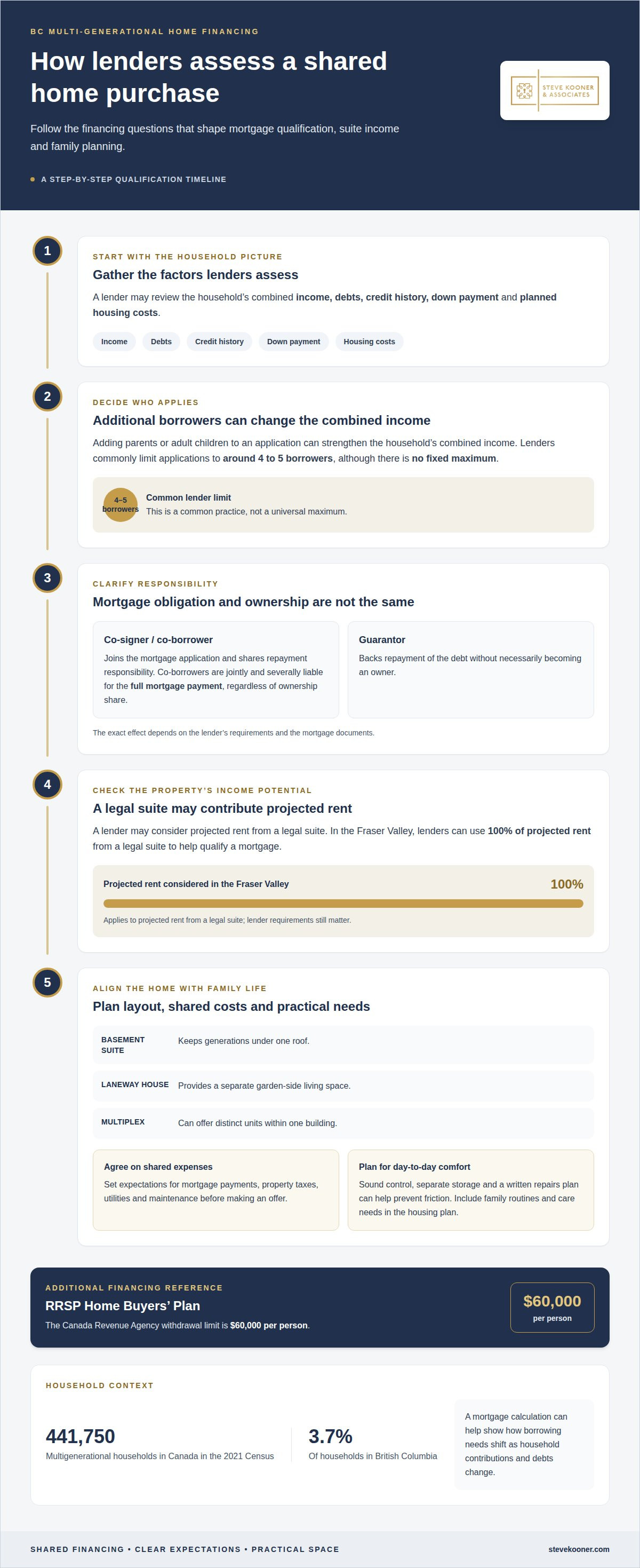
Lenders assess a household’s income, debts, credit history, down payment and planned housing costs. Adding parents or adult children to an application can strengthen the combined income, but each co-borrower is jointly and severally liable for the full mortgage payment, regardless of their ownership share. In practice, lenders commonly limit applications to around 4 to 5 borrowers, although there is no fixed maximum.
A co-signer joins the mortgage application and shares responsibility for repayment; a guarantor backs the debt without necessarily taking ownership. A lender may also consider projected rent from a legal suite. In the Fraser Valley, lenders can use 100% of projected rent from a legal suite to help qualify a mortgage. Canada Revenue Agency sets the Canadian RRSP Home Buyers' Plan withdrawal limit at $60,000 per person.
A property’s layout affects both financing and day-to-day life. A basement suite keeps generations under one roof, while a laneway house provides a separate garden-side living space. A multiplex can offer distinct units within one building. For example, relatives might share a house and mortgage while using private entrances and agreed quiet hours. Sound control, separate storage, and a written plan for repairs can help prevent friction.
Shared expenses need clear expectations. Families can agree how they divide mortgage payments, property taxes, utilities and maintenance before making an offer. Cultural traditions may shape whether grandparents share meals or help care for children, so include those needs in the housing plan. Canada had 441,750 multigenerational households in the 2021 Census, and they represented 3.7% of households in British Columbia. A mortgage calculation can help families explore how borrowing needs shift as contributions and debts change.
What qualifies as a multi-generational home in British Columbia?
In British Columbia, a multi-generational home is defined by how a household uses the property, not by a particular building style. Parents, adult children, grandparents, or other relatives may share a home or live in separate, self-contained spaces on the same property. A main house, basement suite, laneway house, or connected lock-off unit can support either arrangement.
Layouts vary. A legal secondary suite typically has its own kitchen, bathroom, bedroom, and living area, as well as a separate entrance. Some townhouse and apartment lock-off units also have separate entrances, full kitchens, and bathrooms. A laneway or backyard unit creates more distance from the main home, while a shared house keeps relatives closer to common areas.
Provincial small-scale multi-unit housing rules require municipalities to allow three or four units. The requirement covers most single-family lots. Rules also permit secondary suites or accessory dwelling units on almost all single-family lots. This applies in municipalities with more than 5,000 people. Local zoning and servicing shape what a specific property can support.
For example, grandparents might use a basement suite for private routines. Adult children could share meals in the main kitchen. A laneway home may suit relatives who value a separate entrance and quieter living space. Families can weigh privacy, accessibility, shared rooms, and changing household needs. A local view of available homes from Steve Kooner & Associates can connect those priorities with suitable properties in our service area.
Can family members co-own a home in BC, and what ownership structures are available?
Yes. Family members can buy a home together, but mortgage responsibility and registered ownership are separate matters. One parent, for example, might qualify for the mortgage while adult children contribute to the down payment. If several relatives borrow together, being named on the mortgage does not automatically determine each person’s ownership share.
Families can choose sole ownership or shared title. With sole ownership, one person holds title while relatives contribute to household expenses under a separate family agreement. With shared title, more than one relative is registered as an owner. Joint tenancy and tenancy in common are two forms of shared title. The choice affects how ownership is recorded and should reflect the family’s intentions.
For example, siblings and a parent can agree on ownership shares, mortgage contributions, property taxes, maintenance, and what happens if someone wants to leave. Put those expectations in a written agreement before making an offer. In B.C., a co-owner may legally force the sale of the entire property under the Partition of Property Act if no prior legal contract prevents it. That possibility makes an exit plan important, even when everyone expects to stay together.
Before making an offer, have a lawyer review the title structure, financing arrangements, and principal-residence questions. Discuss how the agreement addresses missed payments, major repairs, a family member’s death, or changed living plans. Clear terms can help protect both the investment and family relationships.
Steve Kooner & Associates: Market Analysis & Buying Strategy
Steve Kooner & Associates helps families connect their household needs with a practical property search through Market Analysis & Buying Strategy. When relatives have settled their financing and ownership plans, the team can help assess how a property’s layout, location, and market position fit their shared priorities. That guidance can support choices among detached homes, presale opportunities, and new construction.
For a multi-generational purchase, the right fit involves more than bedroom count. Separate living areas, access, and space for family routines all affect how a home may work over time. Steve Kooner & Associates can guide your property search and support the offer process, helping your family make a considered choice.
Contact Steve Kooner & Associates to discuss your family’s home-buying plans.
Build a home plan your family can grow into
A thoughtful approach to buying a multi-generational home in BC starts with a shared picture of daily life. Each generation can identify what matters most, from quiet space to time together. Turn those priorities into a practical property brief to give the search direction without assuming everyone wants the same things.
Use the brief to consider how a home could support changing routines over time. Think about privacy, independence, accessibility, and shared spaces as parts of the same decision. If priorities differ, revisit the plan before committing. A clear conversation now can help protect both the purchase decision and the relationships behind it.
With a common direction, your family can move forward with more confidence and focus. The right next step is a conversation grounded in your goals and the kind of home you hope to share.
Your family’s next chapter can begin with a thoughtful property choice.
Frequently Asked Questions
05What happens if one family member wants to sell their share of the home?
The family’s ownership agreement should explain how an owner can exit. It can state whether the remaining owners have the first opportunity to buy the departing owner’s share, how its value will be determined, and how the purchase will be funded. Agreeing on a process before buying gives relatives a shared reference point if plans change.
06Can multiple family members be on one mortgage in Canada?
Yes, a mortgage application can include multiple family members. Each applicant provides information such as income, debts, credit history, and down-payment contributions for the lender’s assessment. Parents and an adult child, for example, can prepare their financial records together. Align the borrower list with the proposed ownership structure so the financing and title arrangements are clear.
What is the average price of a multi-generational home in BC by city or region?
There is no single representative price for multi-generational homes across B.C. A detached home with a basement suite differs from a property with a separate backyard unit or multiple living areas. Compare similar properties in the same community, taking condition, layout, lot, and suite status into account. Langley, Surrey, and Abbotsford each call for a local comparison.
What financing and mortgage options are available for buying a multi-generational home in BC?
Families can apply together as co-borrowers, or one person can apply with another person supporting the application as a guarantor. The appropriate structure depends on the borrowers’ finances and the family’s plans for owning the property. Eligible buyers can also use registered savings programs: the FHSA and RRSP Home Buyers’ Plan have different eligibility and repayment rules.
What BC property transfer tax, GST, and other taxes apply when buying a multi-generational home?
BC Property Transfer Tax is 1% on the first C$200,000, 2% on the portion up to C$2 million, and 3% on the portion above C$2 million. GST treatment can be relevant to new construction. Include property taxes in ongoing ownership costs, and distinguish those from taxes due during the purchase.
Disclaimer
"Not intended to solicit buyers or sellers that are under current agency agreement" "Each RE/MAX office is independently owned and operated"


