

Could pricing below market actually cost you more than pricing too high? In the Fraser Valley, a quick sale starts with local evidence, not an automatic discount. The Fraser Valley Real Estate Board reported a 9% sales-to-active-listings ratio in September 2026, reflecting buyer’s-market conditions. That makes a pricing strategy for a quick home sale especially important: an ambitious asking price may limit interest, while pricing too low can leave value on the table.
Nearby sale prices can help, but only when you compare homes with similar locations, property types, condition, and features. This guide explains how a comparative market analysis can help establish a realistic price range, how below-market, at-market, and above-market approaches differ, and how to assess buyer feedback after listing. You’ll also learn how presentation and marketing can support your pricing plan.
Key Takeaways
- Define your timing, priorities, and acceptable offer terms before setting an asking price.
- Use a comparative market analysis, current competing listings, and your home’s condition to shape a pricing strategy for a quick home sale.
- Assess price alongside presentation and the alternatives buyers can view.
- Consider showing activity and buyer comments together, then revisit the market evidence and your goals before adjusting the price.
What Does a Quick-Sale Pricing Strategy Mean in the Fraser Valley?
A quick-sale pricing strategy uses current market evidence to position your home for serious buyer interest while taking your goals into account. It can help attract attention, but it cannot promise a sale by a particular date. Whether you’re selling in Langley, Abbotsford, Chilliwack, Mission, Hope, Kent, Agassiz, Harrison Hot Springs, the Township of Langley, Surrey, North Delta, Maple Ridge, or Pitt Meadows, start with local evidence rather than an automatic discount or a neighbour’s asking price.
Price is one part of a buyer’s decision. Buyers also compare condition, presentation, location, and the other homes available to view. A well-prepared property may stand out among similar listings; repairs or dated finishes may affect how buyers assess it. General approaches outlined in Pricing Strategies offer useful context, but your home’s position should reflect its specific market and competition.
Your asking price introduces the property to buyers. It is not a guaranteed measure of market value or the final negotiated sale price. Market value is an estimate informed by relevant evidence; the sale price is the amount agreed to in a transaction. A tailored home evaluation can help establish a grounded starting point.
Why nearby listings and recent sales matter
Compare homes that resemble yours in location, property type, condition, and relevant features. Recent completed sales show what buyers agreed to pay, while active listings show the alternatives buyers can consider now. Neither provides the full picture on its own: an asking price is not proof of value, and a completed sale may reflect differences in condition or terms.
A Comparative Market Analysis brings these signals together to inform your pricing strategy for a quick home sale. MLS® data can contribute to the analysis, but it is not guaranteed accurate. Interpret it alongside property details and current local context.
How to Choose a Home Pricing Strategy: A Fraser Valley Process
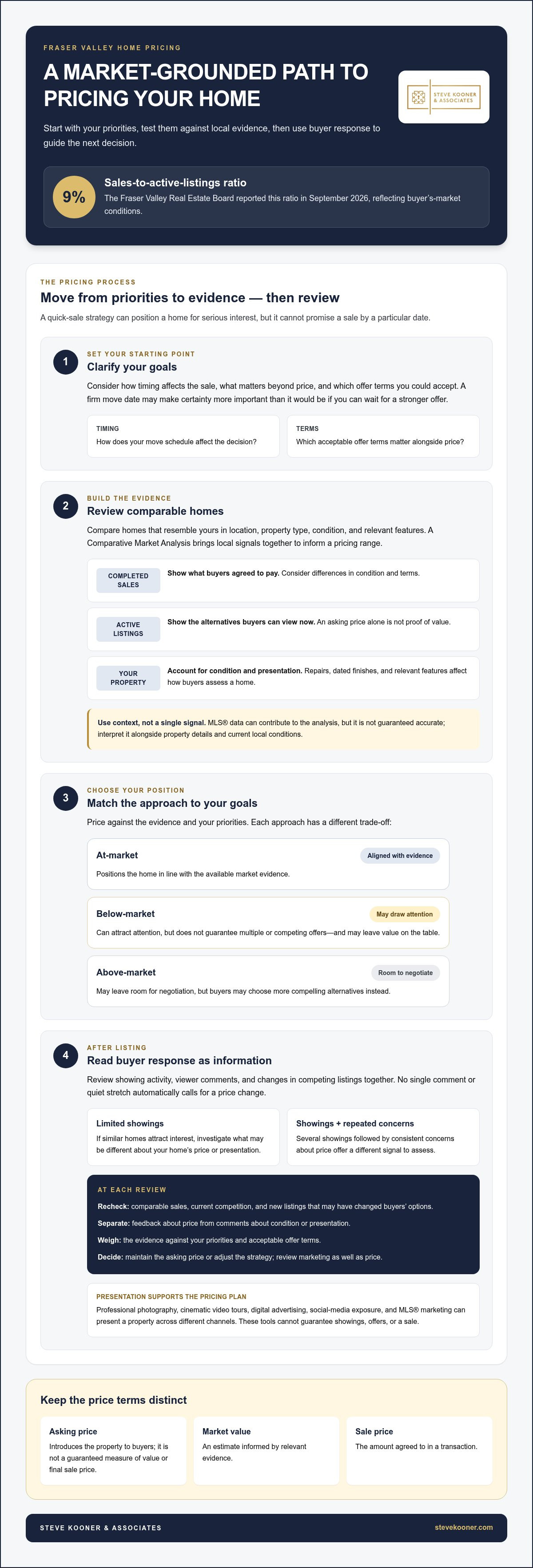
Work from your priorities to the market evidence instead of starting with a number you hope to achieve. This process helps Fraser Valley sellers weigh speed, negotiating flexibility, and value without assuming one approach suits every home.
- Clarify your goals. Consider how your timing affects the sale, what matters beyond price, and which offer terms you could accept. A firm move date may make certainty more important than it would be for a seller who can wait for a stronger offer.
- Review the evidence. Compare relevant completed sales with homes currently competing for buyers, then account for your property’s condition and presentation. Fraser Valley Real Estate Board reports, including its Fraser Valley Real Estate Market Trends, offer broader local context. A Comparative Market Analysis applies comparable evidence to your home.
- Match the approach to your goals. An at-market price positions the home in line with the evidence. Below-market pricing may draw attention, but it does not guarantee multiple or competing offers. An above-market price may leave room for negotiation, yet buyers may choose more compelling alternatives instead.
How to balance speed with a market-supported asking price
A pricing strategy for a quick home sale should balance urgency with what local evidence supports. If an above-market starting point attracts little interest, compare it with recent sales and current competition rather than treating the original asking price as proof of value. Price also works alongside presentation, so preparation and marketing matter.
A complimentary home evaluation can help you consider a market-informed starting range. Steve Kooner & Associates provides home pricing guidance to help align the asking price with your timing and priorities through a tailored home pricing strategy.
How to Adjust Your Pricing Strategy After Listing
After your home is listed, treat buyer response as information to assess, not an automatic reason to change the price. Review showing activity, comments from viewers, and changes in competing listings together. For example, limited showings while similar homes attract interest may point to a different issue than several showings followed by consistent concerns about price.
Before recommending an adjustment, revisit comparable sales and current competition. Check whether new listings have changed buyers’ options, and consider whether feedback relates to price, condition, or presentation. Then weigh that evidence against your priorities and acceptable terms. Make a considered decision rather than reacting to one comment or a quiet stretch.
Marketing helps buyers see what a home offers at its asking price. Professional photography, cinematic video tours, digital advertising, social-media exposure, and MLS® marketing can present a property across different channels. These tools support the pricing plan but cannot guarantee showings, offers, or a sale. If the response is muted, review both the price and the way the property is being presented.
Build a clear review and next-step plan
Set regular check-ins with your real estate team to review activity, buyer comments, and nearby competition. There is no universal timeline or showing threshold that dictates a price change. At each check-in, compare the evidence with your goals, discuss whether the marketing needs attention, and decide whether to maintain the asking price or adjust the strategy. As Fraser Valley conditions shift, Steve Kooner & Associates can adapt its pricing and marketing guidance.
If you’re preparing to list or want to revisit your next steps, request a complimentary home evaluation or contact the Fraser Valley team. Keep your pricing strategy for a quick home sale grounded in current evidence and your priorities, including after the listing goes live.
Take the Next Step With Confidence
Your next move doesn’t have to be a guess. A thoughtful pricing strategy for a quick home sale starts with a clear picture of your home’s place in the current Fraser Valley market and the priorities that matter most to you. Local guidance can help you make informed decisions while keeping your plans in focus.
Steve Kooner & Associates is a Top 1% Fraser Valley Real Estate Board team and a Western Canada Top 100 team. Start with a complimentary, no-obligation home evaluation to discuss a market-informed path forward, without a promised sale price or timeline.
Request a complimentary home evaluation
Build a strategy around your home, your timing, and the Fraser Valley market. Request your complimentary home evaluation to take the first step.
Frequently Asked Questions
Should I price my home below market value for a quick sale?
Not necessarily. A below-market asking price may attract attention, but it does not guarantee multiple offers or a higher final sale price. If comparable Langley homes give buyers plenty of choice, a lower price may help your listing stand out. If your home needs work, its condition and presentation may also affect interest. Choose a pricing strategy for a quick home sale based on current competition, your property, and your priorities.
How do comparable sales help set an asking price?
Recent sales of similar homes help show what buyers have agreed to pay, but no two properties are identical. A Langley townhome is not automatically comparable to a nearby detached home; condition, layout, and features matter too. Active listings show what buyers can choose now, while completed sales reflect past transactions. Treat MLS® information as a useful reference, not a guarantee of accuracy.
Can an asking price be changed after a home is listed?
Yes. You can review the asking price with your real estate agent as buyer feedback and competing listings provide new context. Repeated comments about affordability may call for a different response than feedback focused on a property feature. Revisit comparable evidence and your goals together before deciding whether a change makes sense. An adjustment cannot guarantee a sale or a particular outcome.
Does a lower asking price always make a home sell faster?
No. A lower price alone cannot ensure a quicker sale. Buyers also consider condition, presentation, available alternatives, and local market activity. Lowering the asking price will not necessarily resolve concerns about repairs or presentation. In Langley and across the Fraser Valley, base your decision on current comparable evidence and your priorities rather than applying an automatic discount.
Disclaimer
"Not intended to solicit buyers or sellers that are under current agency agreement" "Each RE/MAX office is independently owned and operated"


