

What if the right home for your next chapter isn’t smaller, but simply works better? Right-Sizing Homes is about more than giving up space. It means choosing a home that supports your routines, priorities, and plans. If you’re unsure whether to stay, make changes, or move, the answer may not be obvious. More or less square footage alone won’t tell you which option fits.
This guide offers a practical way to assess your current home and compare your options. You’ll consider what could improve by changing how you use your space, what a move might offer, and how local market conditions can shape your plans. With a clear framework and local insight, you can focus on finding the right fit, whether that means staying put or exploring a home in Langley, Surrey, Abbotsford, Mission, or another Fraser Valley community.
Key Takeaways
- Right-Sizing Homes starts with matching your space to your household’s routines and priorities, not simply reducing square footage.
- Audit how you use each room to identify what supports daily life and where your needs may change.
- Compare adapting your current home with selling and buying by measuring each option against your priorities.
- Local market guidance and a complimentary, no-obligation home evaluation can help inform your sale decision.
Right-Sizing Homes Starts With Fit, Not Square Footage
Right-Sizing Homes means choosing a home that supports your household’s needs, routines, and priorities. The right fit might be your current home, used differently, or a different property. More bedrooms or less square footage won’t automatically make daily life easier. What matters is whether the space works for the people living there.
Right-sizing is about making your home fit your life; downsizing specifically means reducing living space. The two can overlap, but they aren’t interchangeable. For a useful overview of downsizing, see Understanding Downsizing in the Context of Right-Sizing. You may need less space in one area and more in another, such as a dedicated workspace or a room for visiting family.
How to recognise when your home no longer fits
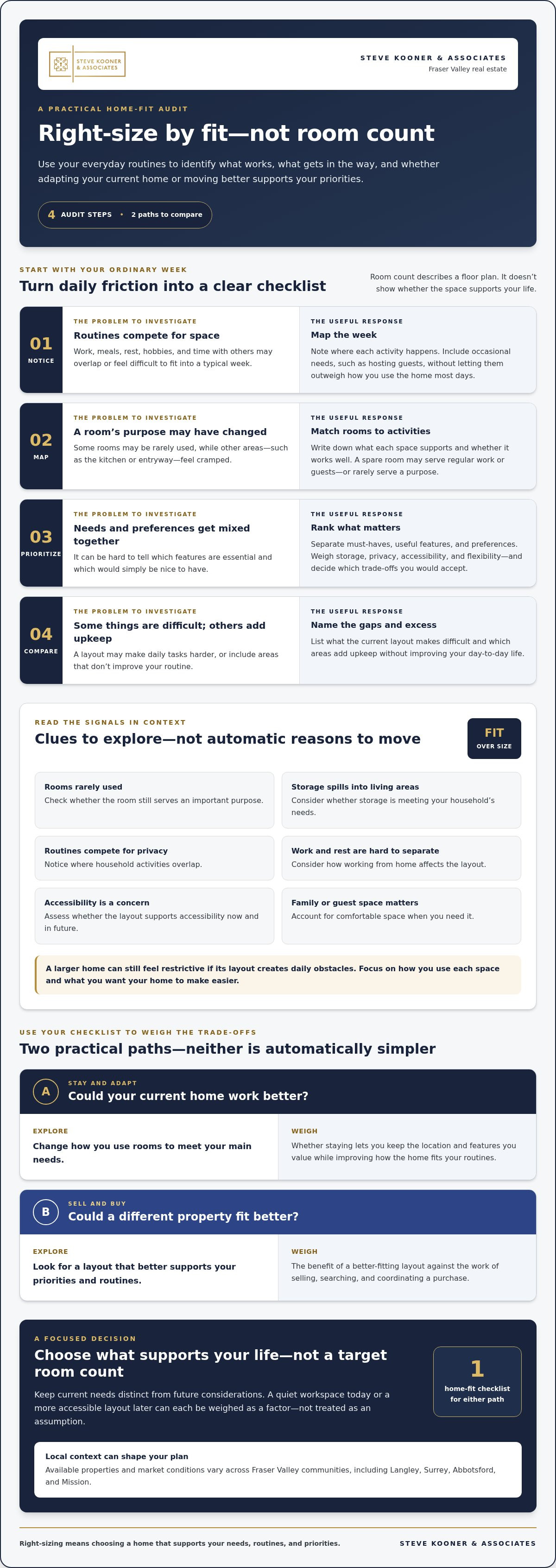
Look beyond the floor plan and consider what happens during an ordinary week. Are some rooms rarely used while the kitchen or entryway feels cramped? Does storage spill into living areas? Do household routines compete for privacy, or does working from home make it difficult to separate work and rest? These are useful clues to investigate, not automatic reasons to move.
Consider whether the layout supports accessibility and whether there’s comfortable space for family or guests when you need it. A room that sits empty most days may still be valuable if it serves an important purpose. By contrast, a larger home may feel restrictive if its layout creates daily obstacles. Focus on how you use each space, what causes friction, and what you want your home to make easier.
A Practical Right-Sizing Homes Audit for Your Needs
Before comparing properties, turn your day-to-day experience into a simple checklist. This makes it easier to separate what you need from what you’re simply used to, whether you’re considering a move now or planning ahead.
- Review your routines. Note where work, meals, rest, hobbies, and time with others happen during a typical week. Include occasional needs, such as hosting guests, but don’t let them outweigh the way you use your home most days.
- Map how each room is used. Write down the activities each space supports and whether it works well. A spare room may be important for regular work or guests, or it may rarely serve a purpose.
- Rank your needs. Separate must-haves from useful features and preferences. Consider storage, privacy, accessibility, and flexibility, then decide which trade-offs you would accept.
- Identify what’s missing or excess. Note what your current layout makes difficult and which areas add upkeep without improving your routine.
Build a home-fit checklist around daily life
Keep current needs separate from future considerations. You may need a quiet workspace today and want a more accessible layout later, but treat each as a factor to weigh rather than an assumption. The Fraser Valley growing-family home guide and empty-nester right-sizing guide offer perspectives for different circumstances while leaving room for your own priorities.
Room count describes a floor plan; it doesn’t show whether the space supports your life. Use your checklist to compare homes by function, not just bedrooms or total area. For local context as you weigh your priorities, explore Fraser Valley real estate guidance.
Turn Your Right-Sizing Homes Plan Into a Fraser Valley Move
Use your checklist to compare two practical paths: making your current home work better or selling and buying a different property. If you stay, consider whether changing how you use the rooms could meet your main needs while keeping the location and features you value. If you move, weigh the benefit of a better-fitting layout against the work of selling, searching, and coordinating a purchase. Neither option is automatically simpler. The better choice depends on what matters most to you.
Local market guidance can help put your options in context. Available properties and market conditions vary across Fraser Valley communities, including Langley, Surrey, Abbotsford, and Mission. A complimentary, no-obligation home evaluation can inform your sale planning as you consider whether a move supports your goals.
Coordinate the next home decision with your selling plan
Buyer and seller representation can help coordinate the process, from evaluating your current property and planning a search to reviewing offers and managing transaction details. When comparing prospective homes, use your priorities to look beyond a familiar floor plan. A different property type or layout may suit your routines better, even if its room count or overall space differs from what you have now.
A clear home-fit checklist turns a broad property search into a focused search for what matters in your daily life. Right-Sizing Homes is a personal decision. A considered plan helps you assess the trade-offs without rushing toward a particular outcome. If you’re ready to explore your options, discuss your Fraser Valley real estate goals with the team.
Take Your Next Step With Confidence
Your next move doesn’t have to be immediate or all-or-nothing. Take time to clarify what would make home life work better, then use that understanding to guide your decision. Right-Sizing Homes is about choosing an option that supports your priorities, whether that means exploring a sale or staying where you are.
Steve Kooner & Associates offers Fraser Valley market knowledge and buyer and seller guidance to help you consider your options. The team is ranked in the Top 1% of the Fraser Valley Real Estate Board and Western Canada Top 100, and offers a complimentary, no-obligation home evaluation to inform your planning.
A thoughtful next step can bring greater confidence. Contact Steve Kooner & Associates to discuss your Fraser Valley real estate goals.
Frequently Asked Questions
Is right-sizing only for retirees?
No, right-sizing can be useful at any age or stage of life. A shift to hybrid work, a new household arrangement, or a change in how you use your neighbourhood may prompt a fresh look at your home. Whether you’re in Langley, Township of Langley, Surrey, North Delta, Abbotsford, Mission, Chilliwack, Hope, Kent, Agassiz, Harrison Hot Springs, Maple Ridge, or Pitt Meadows, base the decision on your own priorities, not an age-based expectation.
Can a home office be part of a right-sizing plan?
Yes, a home office can be an important part of Right-Sizing Homes. If you take calls regularly, for example, a desk in a shared living area may not provide enough privacy, while a dedicated room could be more space than you need. Consider whether a quiet corner, a flexible room, or a separate office best suits your work pattern, and whether the space can serve another purpose outside working hours.
What accessibility needs should I consider when right-sizing a home?
Consider daily movement and how easily you can complete routine tasks. Notice whether carrying laundry between floors is difficult, whether an entrance feels manageable, or whether the bathroom layout allows comfortable use. Prioritise what matters to your household, then compare those needs with your current home and any prospective property. This keeps accessibility in the decision without assuming what support you may need later.
Disclaimer
"Not intended to solicit buyers or sellers that are under current agency agreement" "Each RE/MAX office is independently owned and operated"


