

The lowest monthly fee can look like the best deal, but it may leave owners with more maintenance costs or future repair pressures. If you’re researching strata fees Langley buyers encounter, the monthly amount is only part of the picture: what’s included and how well the building is planning ahead matter just as much.
Before comparing homes, make a simple side-by-side list of each property’s fee, inclusions, reserve contributions and known maintenance needs. This guide explains common fee components, why they vary between Langley strata properties, and which records, including financial statements, meeting minutes and depreciation reports, can help you make a more informed purchase decision.
Key Takeaways
- Strata fees Langley buyers encounter contribute to shared costs, but the specific services and expenses covered vary by property.
- Compare each property’s inclusions and maintenance needs alongside its operating budget and reserve contributions, not by the monthly fee alone.
- A higher fee may support more services or planned upkeep; a lower fee doesn’t automatically mean better value.
- Review available strata information and compare each home’s full monthly ownership costs against your priorities.
What Do Strata Fees in Langley Usually Cover?
Strata fees are regular contributions collected by a strata corporation to pay shared property expenses. For buyers comparing strata fees Langley homes carry, think of them as the building’s shared operating budget, not a standard package of services. The corporation’s approved budget and each owner’s unit entitlement help determine the contribution.
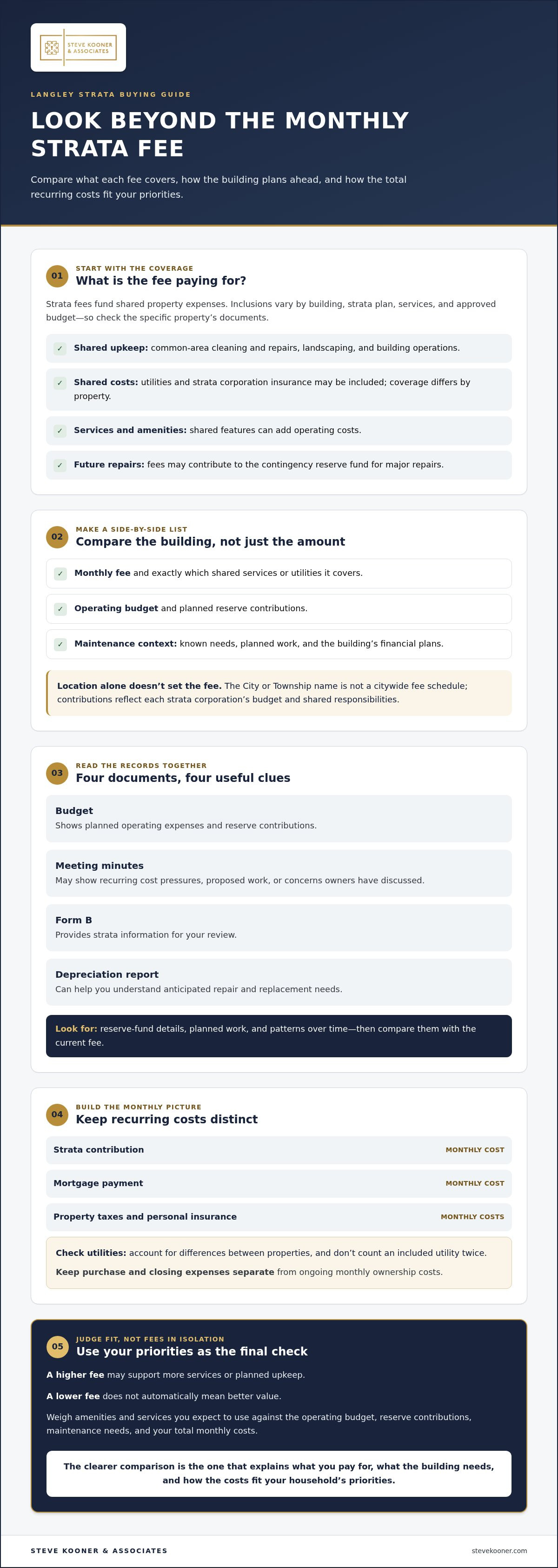
Depending on the building, fees may contribute to common-area cleaning and repairs, landscaping, building operations, shared utilities and the strata corporation’s insurance. They may also include contributions to the contingency reserve fund, which helps prepare for future major repairs. Amenities and services can add operating costs, while properties with fewer shared features may have different expenses. Strata management generally involves coordinating these shared responsibilities and finances.
There isn’t one set list of inclusions. Fees and coverage vary by building, strata plan, services and approved budget. A fee may cover water or other utilities in one property but not another. Check the specific listing and strata documents rather than assuming the same service is included across similar homes. Your mortgage, property taxes and personal home insurance are separate ownership costs to include in your budget.
Do strata fees differ between Langley City and the Township?
Langley-area listings may be located in either the City of Langley or the Township of Langley, but the municipality name alone doesn’t determine a property’s strata fees. Contributions are set for each strata corporation based on its budget and shared responsibilities, not by a citywide fee schedule. Two nearby townhomes can have different fees because their services, building needs and financial plans differ.
For a meaningful comparison, note each property’s fee and exactly what it covers. Then review the budget, financial information and shared services to see what owners are funding. This gives you a clearer picture than comparing addresses or monthly amounts alone.
How to Assess Langley Strata Fees Beyond the Monthly Amount
A useful comparison looks past the monthly figure. For strata fees Langley buyers are weighing, compare what each fee supports: shared amenities, services, utilities and routine upkeep. A higher contribution may fund more services or planned maintenance, while a lower one doesn’t prove better value. Consider the operating budget, reserve contributions and maintenance needs together. If an inclusion such as a utility differs between properties, account for that when comparing their overall costs.
Keep recurring costs separate from one-time expenses. Your monthly housing picture may include the strata contribution, mortgage payment, property taxes and personal insurance. Purchase and closing expenses are different costs. The BC home-closing checklist can help you account for transaction costs without mixing them into your ongoing monthly comparison.
What should buyers look for in strata documents?
Review the available budget, meeting minutes, Form B and depreciation report together. The budget shows planned operating expenses and reserve contributions. Minutes can reveal recurring cost pressures, proposed work or concerns owners have discussed. Form B provides strata information, while a depreciation report can help you understand anticipated repair and replacement needs. Note planned work, reserve-fund details and patterns over time, then compare them with the current fee. These records support your evaluation, but aren’t legal advice.
Next, compare the recurring costs against your monthly plan. The team’s mortgage calculator can help you consider how a mortgage payment fits alongside strata fees and other housing expenses. Looking at each property individually helps you assess the full picture before deciding which home best matches your priorities.
Choosing a Langley Strata Home With Fees You Understand
Make the decision in stages rather than choosing by the lowest monthly fee. For strata fees Langley buyers compare, the goal is to understand what each property offers, what its building needs and how the costs fit your household’s plans.
- Identify your priorities. Decide which amenities and services would improve daily life and what you’re comfortable paying for.
- Compare inclusions. Record which shared services and utilities each fee covers. Don’t treat two similar monthly amounts as equivalent if one includes costs the other doesn’t.
- Review strata information. Look at budget details, reserve contributions, maintenance plans and relevant discussions in meeting minutes.
- Calculate total monthly ownership costs. Add the strata fee to your expected mortgage payment, property taxes, insurance and other recurring expenses. Avoid counting an included utility twice.
A higher fee may reflect more shared services or planned upkeep. A lower fee alone doesn’t establish better value, especially if the building’s maintenance needs or financial plans point to costs ahead. Use the documents to develop informed questions about the budget and planned work. Steve Kooner & Associates provides buyer guidance, property evaluation, offer support and transaction assistance to help you compare homes and understand how each fits your priorities. Legal and financial advice should come from the appropriate professionals.
How can buyers compare two Langley strata properties?
Start with similar property types, then compare each home’s services and amenities alongside its budget and maintenance context. For example, a shared amenity may be worthwhile if your household expects to use it, but less valuable if keeping monthly costs down is a priority. Weigh convenience, shared features and total monthly costs against your needs. A side-by-side comparison helps you focus on overall fit, not just fees.
If you’re weighing Langley homes, get local real estate guidance to help assess your options and prepare for your purchase decision.
Move Forward With a Clearer Strata Buying Plan
Turn what you’ve learned into a practical shortlist. As you compare strata fees Langley homes carry, focus on how each property supports your priorities and whether its ongoing costs fit your plans. A clear set of questions makes viewings and document reviews more focused, helping you move from browsing to a confident decision.
Steve Kooner & Associates offers buyer guidance across Langley and the surrounding Fraser Valley communities, including Abbotsford, Chilliwack, Mission, Hope, Kent, Agassiz, Harrison Hot Springs, Surrey, North Delta, Maple Ridge and Pitt Meadows, as well as the Township of Langley. The team helps buyers evaluate properties, prepare offers and navigate transactions with local market context.
Choose a home by considering both how it will work for you day to day and how its ongoing costs fit your plans. Connect with Steve Kooner & Associates to compare Langley properties and take the next step in your home search.
Frequently Asked Questions
What do strata fees in Langley typically include?
Strata fees commonly help pay for shared property expenses, but the exact coverage depends on the building. One townhouse’s fee might include water, while another owner pays that utility separately. Check the listing details and strata records to see which costs are included, then compare them with your expected household expenses when estimating the home’s monthly cost.
How much are strata fees in Langley?
There isn’t one standard amount for every Langley home. The fee depends on the specific strata, its budget and the property’s shared services. When comparing two townhomes, use their actual fees and inclusions rather than a regional average. Then consider whether each amount fits your budget and the building’s financial and maintenance context.
Can strata fees increase after I buy a home?
Yes, strata fees can change if the corporation approves a different budget as shared expenses or plans change. The current fee doesn’t guarantee that the amount will stay the same. Before making an offer, review available budgets and meeting records for signs of planned work or changing costs. Consider appropriate professional advice if you have questions about the documents.
Are strata fees included in a Langley mortgage payment?
No, strata fees are generally paid separately from your mortgage. Add the current fee to your estimated mortgage payment and other recurring ownership expenses to build a realistic monthly budget. If a fee includes a utility, avoid counting that same utility twice. Confirm what the property covers and allow room in your plan for costs that can change.
Disclaimer
"Not intended to solicit buyers or sellers that are under current agency agreement" "Each RE/MAX office is independently owned and operated"


