

A family transfer doesn’t automatically transfer the mortgage. Selling a home to a family member in BC generally means the relative must qualify with the lender, which must consent before a child takes over a parent’s mortgage. The transfer may also have tax consequences, even if little or no money changes hands.
It’s natural to expect an intrafamily home transfer to be straightforward, but the relationship alone doesn’t determine the tax outcome. A property transfer tax exemption may apply to certain qualifying parent-to-child transfers of a principal residence, subject to specific requirements. This guide explains mortgage options, gifts and life interests, and what to understand about fair market value and property transfer tax before registering a change in ownership.
Key Takeaways
- A family member may need to qualify for a new mortgage, and the lender’s consent and underwriting can shape the transfer.
- Compare a gift, a sale, and a life interest to understand how each arrangement affects ownership and future decisions.
- A transfer for a nominal amount may still be treated as occurring at fair market value for tax purposes.
- Explore whether the BC Property Transfer Tax exemption fits the relationship and principal-residence circumstances before choosing a transfer structure.
Can You Transfer a Mortgage to a Family Member?
A mortgage doesn’t automatically transfer when a family member receives a home. In BC, a child taking over a parent’s mortgage needs the lender’s consent, and the lender will assess the child’s ability to qualify. The relative may instead need a separate mortgage to cover the outstanding balance. If the lender allows an assumption, the former owner could remain liable if the new borrower defaults.
Federal tax treatment is separate from mortgage approval. A transfer between relatives may be treated as occurring at fair market value, even if the family agrees on a lower price. When capital gains apply, 50% of a home’s increase in value is added to the transferor’s income for that year. The principal residence exemption may shelter some or all of the gain if the home was the transferor’s principal residence throughout the ownership period.
For example, a parent may transfer title but continue living in the home. The Canada Revenue Agency may consider the parent to have retained beneficial ownership, which can affect the principal residence exemption. A lawyer can help clarify how the transfer agreement describes ownership and occupancy before registration.
Inheritance has a different timeline. Canada has no inheritance tax, but the Canada Revenue Agency generally treats many assets as sold at fair market value immediately before the owner’s death. If an inherited home is valued at C$800,000 on the date of death and sells one year later for C$850,000, the increase is C$50,000. The estate and beneficiary should distinguish this later increase from the home’s value at death.
Before selling your home to a child or another relative, consider the mortgage, tax treatment and intended occupancy together. Make federal tax decisions before the transfer registers at BC’s Land Title Office. Timing matters whether the family plans a sale, a gift or an agreement that preserves the parent’s right to use the property.
Transfer structures, including gifts and life interests
Selling a home to a family member in BC involves more than choosing a price: the transfer structure sets expectations for ownership and occupancy. A sale, gift or life interest can affect payments, documentation and future decisions.
Fair Market Value and Transfer Tax
Fair market value reflects what a property would be worth in an open-market transaction. In BC, Property Transfer Tax is generally based on that value when the transfer registers, unless an exemption applies. The Canada Revenue Agency assumes a Canadian homeowner’s gift or sale to a child for C$1 took place at fair market value. That deemed value can affect tax calculations even if the family exchanges little capital.
Transfer Documentation
A gift letter documents that the transfer isn’t expected to be repaid and records the consideration declared on the BC Property Transfer Tax return. A written agreement can also describe a life interest, reserving the transferor’s right to occupy the property while ownership passes to the recipient. Clarify who handles payments, repairs and other responsibilities to reduce uncertainty. Selling a home to a family member in BC is easier to plan when expectations are documented before registration.
A family sale typically moves from agreeing on terms to signing a contract, arranging financing, preparing transfer documents and registering the change at BC’s Land Title Office. A comparative market analysis can help inform discussion of local value.
A real estate lawyer or notary can handle conveyancing and registration. An appraisal can support a discussion of value, while a home inspection is a separate condition relatives may choose to include.
Disputes may arise over the agreed value, repayment expectations or a parent’s occupancy rights. A written agreement that sets out each party’s responsibilities can reduce misunderstandings.
BC Property Transfer Tax exemption for family transfers
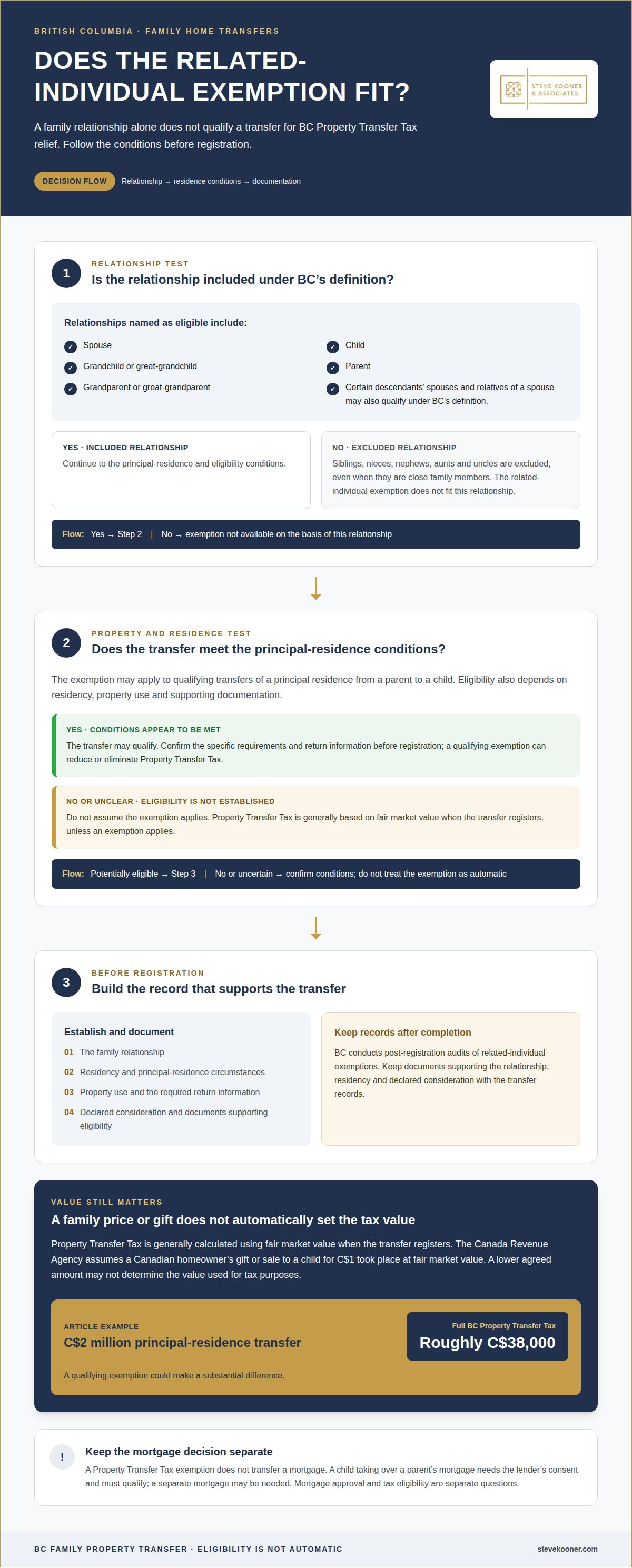
BC’s related-individual exemption may apply to qualifying transfers of a principal residence from a parent to a child. The relationship is only one part of eligibility. Residency, property use and supporting documentation also matter, so a family transfer does not automatically qualify.
Eligible relationships include a spouse, child, grandchild, great-grandchild, parent, grandparent and great-grandparent. Certain descendants’ spouses and relatives of a spouse may also qualify under BC’s definition. Siblings, nieces, nephews, aunts and uncles are excluded, even when they’re close family members.
For an eligible transfer, the exemption can reduce or eliminate Property Transfer Tax. The tax is generally calculated using the property’s fair market value when the transfer registers. That value matters for a family home in Langley or elsewhere in the Fraser Valley, even when relatives agree on a lower purchase amount or a gift.
Before registration, establish the relationship, principal-residence conditions and required return information. BC conducts post-registration audits of related-individual exemptions, so accurate records matter after completion too. Keep documents supporting the family relationship, residency and declared consideration with the transfer records.
For context, full BC Property Transfer Tax on a C$2 million principal-residence transfer would be roughly C$38,000; a qualifying exemption could make a substantial difference. The key is to establish eligibility and documentation before registration, rather than assuming a family connection is enough.
Steve Kooner & Associates: Detached Single-Family Home Sales & Purchases
Steve Kooner & Associates can support your detached-home sale or purchase when a family transfer needs clear market context and transaction coordination. The team’s real estate market guidance and comparative market analysis can help frame a property’s value, while offer review, negotiation and contract management support the transaction from agreed terms through completion.
This support is useful when relatives need to align on the sale price, possession or contract conditions. It can also help buyers and sellers organize the real estate transaction alongside separate mortgage, tax and legal considerations. The team focuses on the property transaction, not tax or legal advice.
Contact Steve Kooner & Associates to discuss your family home sale or purchase.
Plan Your Next Move With Confidence
Selling a home to a family member in BC can shape your family plans and your next real estate move. Once the transfer approach is clear, consider how the property fits your longer-term goals, whether you’re selling, buying or exploring another home. Steve Kooner & Associates supports presale, new-construction and detached single-family home sales and purchases, helping you assess the real estate side of your plans and move forward with a clear transaction strategy. Tax and legal decisions remain separate considerations, but a thoughtful property plan can help you coordinate the steps and keep your priorities in view.
With a considered plan and the right support, you can take your next step with greater clarity and confidence.
Frequently Asked Questions
How to Sell the Family Home?
Start by agreeing on the sale terms and who will handle each decision. A comparative market analysis can help relatives discuss a realistic asking price, while the contract should set out the price, conditions and possession date. Sellers must disclose defects they know about. Document decisions and amendments so buyers and family members share the same understanding throughout the transaction.
Can You Gift a House to Your Child?
Yes, a parent can transfer a home to a child as a gift, but the title change still requires formal documentation. A gift letter can record that repayment isn’t expected and clarify the consideration declared for BC’s Property Transfer Tax return. If the home has a mortgage, the lender’s consent matters when the child is taking over the borrowing.
Can my parent stay in the home after transferring it to me?
Yes, the transfer arrangement can reserve your parent’s right to occupy the home through a life interest. Put the arrangement in writing and clarify who pays ongoing expenses, handles repairs and decides when it ends. Continued use may also affect how the Canada Revenue Agency views beneficial ownership and the principal residence exemption.
Do I have to pay capital gains tax if I transfer my home to my child?
Not necessarily. The tax result depends partly on whether the home qualifies for the principal residence exemption and the ownership period involved. If it was the transferor’s principal residence throughout ownership, the exemption may shelter some or all of the gain. A transfer can have tax consequences even without a conventional sale price, so plan before registration.
How can I be sure I’ll get my money?
Use a written sale contract that clearly records the purchase price, payment schedule, and what happens if a payment is missed. If you finance part of the purchase through a vendor takeback mortgage, put its terms in a written legal agreement and state the interest rate, including if it’s 0%. Clear records give both relatives a shared reference.
Disclaimer
"Not intended to solicit buyers or sellers that are under current agency agreement" "Each RE/MAX office is independently owned and operated"


