

What if one co-owner wants to sell, but the others don’t? In British Columbia, a co-owner with a 50% interest or greater generally has a prima facie right to seek a court-ordered sale, unless there’s a good reason not to sell. Selling a jointly owned property doesn’t always mean one person can simply decide the whole process alone, but disagreement doesn’t necessarily end the matter.
When ownership plans no longer align, it helps to know your options. In British Columbia, one co-owner can apply to court for a sale, but the outcome depends on the circumstances and any grounds to refuse the application. This guide explains how ownership type, relationship circumstances and disagreements over proceeds can affect selling a jointly owned property.
Key Takeaways
- In British Columbia, a court application about co-owned property is governed by the Partition of Property Act.
- Ownership structure affects each co-owner’s rights, so understanding how title is held can clarify the available options.
- A possible right of first refusal or a feasible way to divide the property may affect whether a court orders a sale.
- If the property can’t reasonably be divided, a court-ordered sale may provide a way to resolve the co-owners’ dispute.
Can a Jointly Owned Property Be Sold by One Owner?
In British Columbia, a co-owner may apply to court for a partition or sale under the Partition of Property Act. Whether the court orders a sale depends on the circumstances, including whether there is a reason to refuse the application.
Partition Applications and Court-Ordered Sales
A partition application asks the court to divide co-owned property or order its sale. A co-owner with a 50% interest or greater generally has a prima facie right to seek sale, unless a good reason weighs against it. In Nguyen v. Pham, 2023 BCSC 1246, a right of first refusal was recognized as a possible reason to refuse a sale. This can matter when owners cannot reach agreement.
Sale Orders and Proceeds Distribution
A court can decide whether a property should be sold separately from how the proceeds are distributed. That distinction matters if co-owners disagree about their interests or contributions: a sale may proceed even while the allocation remains unresolved. The court may consider whether proceeds can be held in trust to protect competing claims. A sale order does not necessarily resolve every financial issue between the owners.
Signatures, Costs, and Sale Steps
For a voluntary sale, registered owners generally need to authorize the transfer. A court-ordered sale proceeds under the court order. A real estate professional can coordinate the listing, offers and signing logistics—a process exemplified by consultancy-led estate agencies such as Nikki Homes—while legal professionals handle transfer documents. Mortgage payouts, registered liens, conveyancing expenses and closing adjustments affect the net proceeds. Identifying these items early helps clarify what may remain for distribution after closing.
What if one co-owner wants to sell and another doesn't?
In British Columbia, the type of ownership and the owners’ relationship can shape their options when they disagree. A buyout, negotiated sale or court application may provide a way forward.
Joint Tenancy and Tenancy in Common
Joint tenancy and tenancy in common are different ways to hold registered title. A title search identifies the registered ownership and gives co-owners a starting point for discussion. Tenants in common can hold distinct, unequal shares. For former spouses or romantic partners, the Family Law Act may apply instead of the Partition of Property Act. This distinction matters because family property issues can affect how a disagreement proceeds.
Co-owner Buyouts and Valuation
A buyout is an agreement for one co-owner to acquire another’s interest rather than sell the entire property. The parties can use an independent appraisal or market analysis to establish a value, then account for each ownership share and the outstanding mortgage when negotiating the payment. For example, an agreed value and a recorded ownership share provide a basis for discussion, not an automatic final amount. Transfers between spouses or common-law partners may qualify for a tax-deferred rollover under section 73(1) of Canada’s Income Tax Act.
Resolving Disputes Over the Sale
Disputes about repairs, listing price, or choosing a realtor are often addressed through a written agreement covering responsibilities and decision-making. A real estate professional can provide home valuation guidance to inform a proposed asking price, while offer review and negotiation can help clarify terms. Keep ownership shares, mortgage obligations, and any family law concerns distinct from practical listing decisions. If agreement fails, a co-owner may seek partition and sale through the British Columbia court process.
Property that cannot reasonably be divided
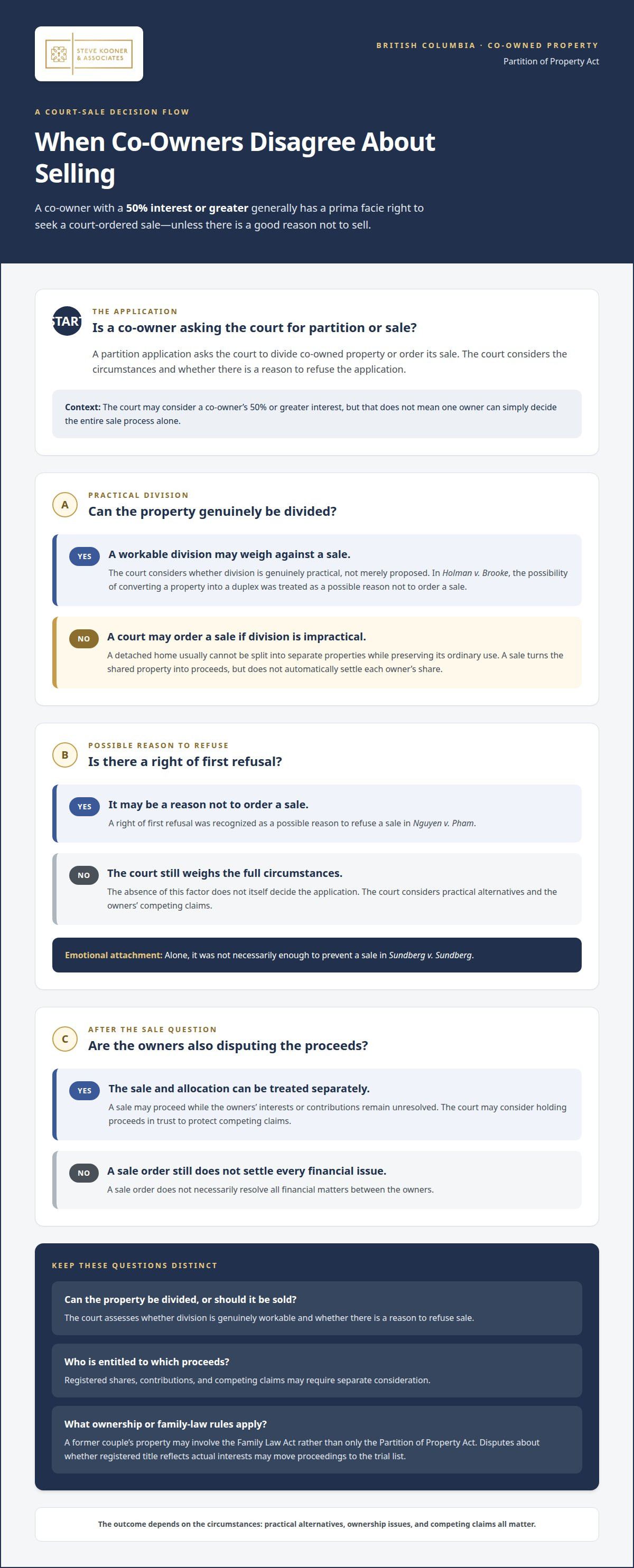
In British Columbia, a court may order the sale of co-owned real estate when the property cannot practically be divided. A detached home, for example, usually cannot be split into separate properties while preserving its ordinary use. A sale turns the shared asset into proceeds, but does not automatically resolve disputes about each owner’s share. Tenants in common may have unequal registered interests, so distribution can remain a separate issue.
Physical division can still matter. In Holman v. Brooke, 2022 BCSC 526, the possibility of converting property into a duplex was treated as a possible reason not to order a sale. The court considers whether division is genuinely workable, rather than merely proposed. A right of first refusal may also affect the decision, as recognized in Nguyen v. Pham, 2023 BCSC 1246. By contrast, emotional attachment alone was not necessarily enough to prevent sale in Sundberg v. Sundberg, 2022 BCSC 2188.
Ownership disputes can complicate the transaction. If parties contest whether registered title reflects their actual interests, partition proceedings may move to the trial list, as in Ackerman v. Ackerman, 2024 BCSC 1702. A former couple’s property may also involve the Family Law Act, rather than only the Partition of Property Act. Where an owner has died, the estate’s role depends on how title was held. These distinctions affect who can participate in a sale and how proceeds may later be allocated.
A court order can provide a way forward when the owners cannot agree and dividing the property is impractical. The court weighs practical alternatives and the parties’ competing claims, rather than simply granting each owner’s preferred outcome.
Steve Kooner & Associates
Steve Kooner & Associates can help you plan the real estate sale once the co-owners are ready to proceed. In the Fraser Valley, the team provides market guidance, pricing strategy, listing preparation, professional marketing, offer negotiation, and transaction support. This can help co-owners coordinate practical sale decisions, from positioning a detached home to reviewing offers and managing the transaction.
If ownership rights, proceeds or a court application are still unresolved, seek legal advice on those matters. Real estate guidance supports the sale process, not legal decisions. When the owners are ready to list or consider an offer, Steve Kooner & Associates can help organize the sale around the agreed plan.
Contact Steve Kooner & Associates to discuss your property sale.
Choose a Clear Next Step
Selling a jointly owned property is easier to manage when ownership questions and the sale plan are treated as related but distinct decisions. Before proceeding, consider what outcome you and the other owners can support, what remains unresolved and what professional guidance each issue requires. A clear plan can keep practical decisions moving while ownership or legal questions receive the attention they need.
When the owners are ready to proceed, Steve Kooner & Associates can support the real estate transaction. The team works with presale homes, new construction and detached single-family homes, helping clients assess the market, prepare a sale, and manage offers and transaction details.
A thoughtful next step can bring structure to a complicated decision and help you move forward with greater confidence.
Frequently Asked Questions
Do all co-owners need to use the same lawyer?
No. Co-owners whose interests align may use one lawyer for the transaction, but shared representation may not be suitable if their interests diverge. For example, disagreement about ownership shares or proceeds can create competing interests. Independent legal advice can help each owner understand their position, especially when a dispute involves title, contributions or family circumstances.
Does Owning More Than Half the Property Make a Difference?
In British Columbia, a co-owner with a 50% interest or greater generally has a prima facie right to apply for a court-ordered sale. That doesn’t mean they can sign for every registered owner or complete a voluntary sale alone. The court can consider whether there’s a good reason not to order a sale, including a workable alternative.
Does it matter if the co-owners aren't related to each other?
Not by itself. Unrelated co-owners can still hold registered interests and face practical questions about a sale. Their relationship may matter if they are former spouses or romantic partners, because British Columbia’s Family Law Act may apply to their co-owned property. For friends, siblings or business partners, title and any co-ownership agreement can help define their interests.
How are sale proceeds split if ownership is 60/40 (or any unequal share)?
If title records a 60/40 tenancy in common, those shares provide a starting point for allocating proceeds. When selling a jointly owned property, the amount available for distribution also reflects transaction costs, mortgage payout, and registered encumbrances. A separate agreement or unresolved claim about beneficial ownership may affect the final allocation, so completing the sale doesn’t necessarily settle every dispute about entitlement.
I Own 50% of a Property: What Are My Rights?
In British Columbia, a 50% interest generally gives you a prima facie right to apply for a court-ordered sale, subject to reasons the court may accept against sale. Selling a jointly owned property still doesn’t automatically let you transfer the other registered owner’s interest. Your options also depend on title, any co-ownership agreement, and whether family law applies to your circumstances.
Disclaimer
"Not intended to solicit buyers or sellers that are under current agency agreement" "Each RE/MAX office is independently owned and operated"


