
Self-employed income can make mortgage approval more paperwork-heavy, but it doesn’t automatically put homeownership out of reach. If you’re buying a home when self-employed in BC, lenders commonly assess your income history over the past two years and focus on net income rather than total business revenue. According to the Canada Mortgage and Housing Corporation, homes priced between C$500,000 and C$1 million require a minimum down payment of 5% on the first C$500,000 and 10% on the portion above it. For homes over C$1 million, a 20% down payment is required to avoid mortgage insurance.
That can feel like a tougher path when business income fluctuates or tax deductions lower your reported net income. Understanding how lenders assess earnings and how purchase-price thresholds affect your cash needs can help you prepare.
This guide covers the income history and documents that may support your mortgage application, how minimum down payments change with purchase price, and whether first-time buyer relief from BC Property Transfer Tax may apply.
Key Takeaways
- Prepare tax returns, Notices of Assessment, and business financial records to help document your income for a mortgage application.
- Review your credit profile, savings, and ongoing debts as part of your home-buying budget.
- Plan your available cash around the home’s price, applicable down-payment tier, and other purchase costs.
- Explore whether you meet British Columbia’s first-time buyer relief criteria before budgeting for Property Transfer Tax.
1. Self-Employment in BC: Why Is Financing So Hard?
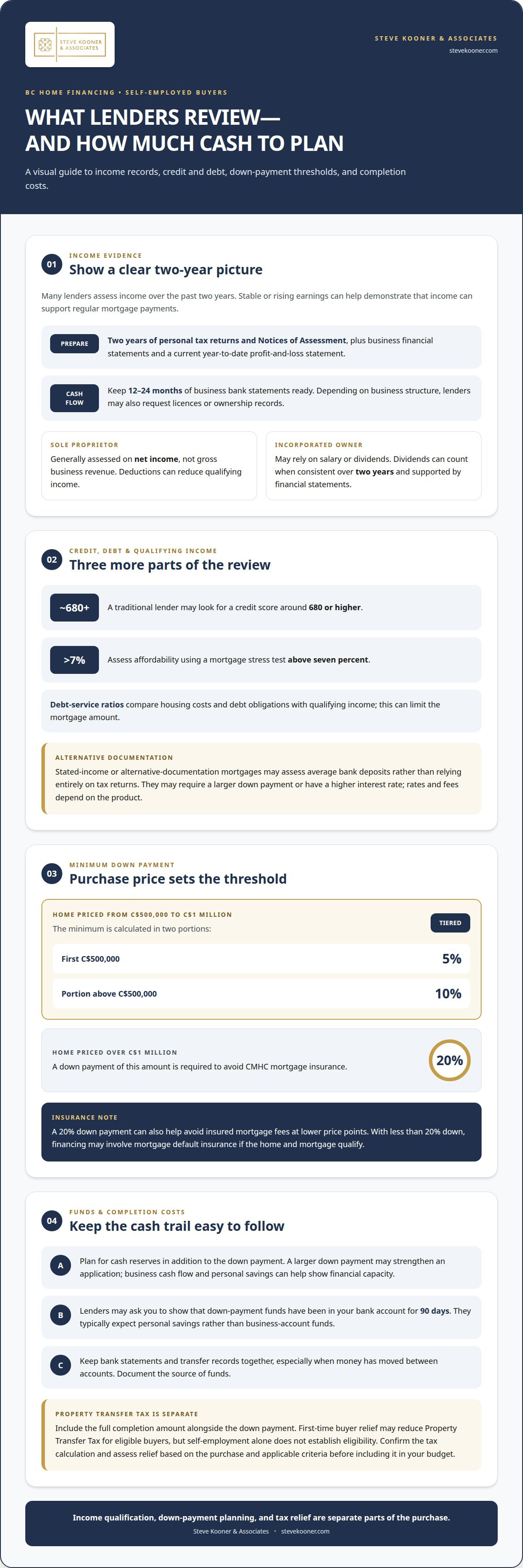
Buying a home when self-employed in BC starts with showing a lender reliable personal income. Many lenders assess income over two years and may request two years of personal tax returns and Notices of Assessment. Stable or rising earnings can help show that your income can support regular mortgage payments.
For buying a home when self-employed in BC, organize tax returns, financial statements, and a current year-to-date profit-and-loss statement. Keep 12 to 24 months of business bank statements ready to show cash flow. Depending on your business structure, lenders may also request business licences or ownership records.
Credit and debt affect approval too. A traditional lender may look for a credit score around 680 or higher. Debt-service ratios compare housing costs and debt obligations with qualifying income, which can limit the mortgage amount. Assess affordability using a mortgage stress test above seven percent. A mortgage calculator can help model payments.
Sole proprietors are generally assessed on net income, not gross business revenue, so deductions can reduce qualifying income. Incorporated business owners may rely on salary or dividends. Dividends can count when they are consistent over two years and supported by financial statements.
Common challenges include declining income, high business expenses, weak credit, significant debt, or incomplete records. Keep personal and business documents organized, and clearly document the source of your funds to support your application.
2. Down payment requirements and home-price thresholds
In BC, the minimum down payment depends on the purchase price, and the funds must be available at closing. For a home priced between C$500,000 and C$1 million, the Canada Mortgage and Housing Corporation states the minimum is 5% of the first C$500,000 and 10% of the portion above C$500,000.
For Canadian homes over C$1 million, the Canada Mortgage and Housing Corporation says a 20% down payment is required to avoid CMHC mortgage insurance. A 20% down payment can also help borrowers avoid insured mortgage fees at lower price points. With less than 20% down, financing may involve mortgage default insurance, if the home and mortgage qualify.
Self-employed borrowers should plan for cash reserves in addition to the down payment. A larger down payment may strengthen an application, while business cash flow and personal savings can help show financial capacity. Alternative mortgage programs may require a larger down payment or have a higher interest rate. Your business structure and income records can affect which financing options suit you, even if you previously earned a salary.
Keep a clear paper trail for your deposit. Lenders may ask you to show that down-payment funds have been in your bank account for 90 days, and they typically expect personal savings rather than business-account funds. Keep statements and transfer records together, especially if money moved between accounts. Use BC home-buying resources to support your purchase planning.
3. British Columbia Property Transfer Tax and first-time buyer relief
In British Columbia, Property Transfer Tax is a separate purchase cost from your down payment and mortgage. First-time buyer relief may reduce this tax for eligible buyers, but self-employment alone does not establish eligibility. Treat tax relief and mortgage approval as separate decisions: one concerns the property transfer, while the other depends on your finances and the lender’s assessment.
Start with the purchase contract and expected completion costs. Ask your conveyancing professional to calculate the tax payable and assess whether first-time buyer relief applies to your transaction. Eligibility depends on program rules and property details, so don’t include relief in your budget until those details have been assessed. The tax amount and any reduction affect the cash you need at completion, not the income a lender uses to qualify your mortgage.
Self-employed buyers can make the financing review clearer by organizing personal tax returns, Notices of Assessment, business financial statements, and bank statements. These records help lenders assess income and business cash flow. Keep tax-planning documents separate from the Property Transfer Tax calculation: business expenses or deductions may affect qualifying income, while transfer-tax assessment depends on the purchase and applicable relief criteria.
Whether you are employed or run a business, include the full completion amount in your cash plan alongside the down payment. A mortgage broker can explain mortgage options, but lenders make financing decisions based on their own assessment of income, debts, credit, and available funds. A strong application and eligible tax relief address different parts of the transaction. Confirm the tax calculation before finalizing your completion budget.
Steve Kooner & Associates: Market Analysis & Buying Strategy
Steve Kooner & Associates helps you turn mortgage and tax planning into a practical home-buying strategy. Use market analysis and buying strategy to assess suitable properties, compare options, and prepare for decisions with a clearer understanding of the BC market. The team supports purchases of presale homes, new construction, and detached single-family homes.
Consider this guidance when you’re ready to move from financing preparation to choosing a property, or need help weighing a home against your plans. Mortgage financing and tax eligibility are separate matters; property selection and purchase strategy shape the next steps. A focused conversation can help connect your budget, preferred property type, and priorities.
Contact Steve Kooner & Associates to discuss your BC home search.
Shape Your Home Search Around Your Next Chapter
Buying a home when self-employed in BC involves more than securing mortgage approval. Your next step is to match the property, location, and purchase strategy to your needs and plans. Consider how the home will support your day-to-day life and which features matter most before narrowing your search.
Steve Kooner & Associates provides market analysis and buying strategy to help you assess property options. The team supports buyers considering presale homes, new construction, and detached single-family homes. This guidance can help you connect your priorities with the local market as you move from financing preparation to property decisions.
You don’t need every detail settled before starting a conversation. Bring your priorities and questions, and take the next step when you’re ready.
A thoughtful plan can make the path ahead clearer. You’re working toward a home that fits your life and goals.
Frequently Asked Questions
Can You Get a Mortgage as a Self-Employed Homebuyer?
Yes, self-employed buyers can qualify for a mortgage if their documented income, credit, debts, and available funds meet a lender’s criteria. Some lenders may consider one year of self-employment income if you previously worked as a salaried employee in the same field. A clear record of income continuity can help explain how your business earnings support ongoing payments.
How long does the whole process take?
Allow time to prepare before you shop: preparation for many self-employed buyers takes 6 to 12 months. After an offer is accepted in British Columbia, closing usually takes 30 to 90 days. Your preparation may involve gathering financial records and clarifying your budget; the closing period covers the transaction steps between an accepted offer and completion.
How much money do I need to get started?
The amount depends on the home price, your down payment requirement, and funds available for closing and reserves. Start by understanding the applicable down-payment tier, then separate personal savings from business operating funds. Lenders may want evidence that down-payment funds have been in your account for 90 days, so keep statements and transfer records accessible.
How much should I offer on a property?
There isn’t one offer amount that suits every BC property. Consider comparable homes, the property’s condition, your budget, and the terms you can comfortably accept. Your offer strategy should reflect the home’s market position and your priorities, not just its asking price. Keep financing conditions and completion timing aligned with your circumstances.
Self-Employment Is the Norm in BC, So Why Is Financing So Hard?
The challenge is proving dependable personal income from business activity. A lender may assess revenue, business expenses, and cash flow differently from an employee’s regular paycheque. For example, a profitable business can still report modest taxable net income after deductions. Consistent records help explain that difference and give lenders a clearer picture of the business’s financial stability.
Disclaimer
"Not intended to solicit buyers or sellers that are under current agency agreement" "Each RE/MAX office is independently owned and operated"


